
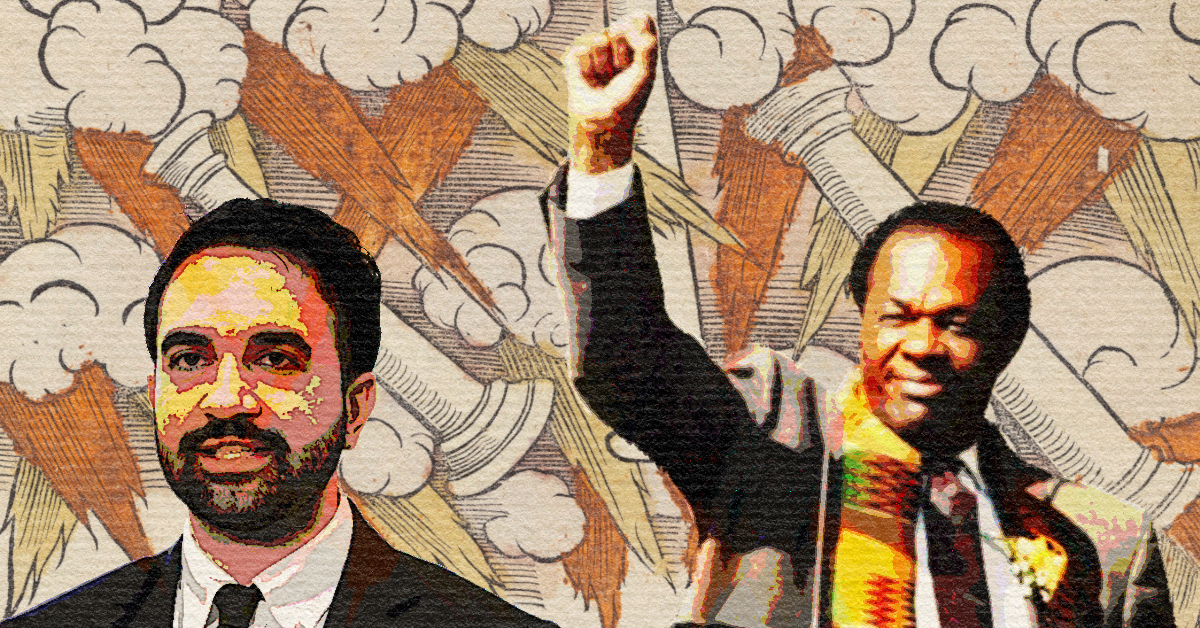
Frankie Fritz is a Metro DC Democratic Socialists of America organizer and socialist in office who currently serves on the Greenbelt City Council. Fritz’s first campaign was as an undergraduate student organizing for fossil fuel divestment, a struggle inspired by the campaign to divest from companies profiting from South African Apartheid.
ON JULY 21, 2026, New York City Mayor Zohran Mamdani posted a video titled, “Benjamin Netanyahu is a war criminal.” The video quickly went viral across social media platforms and drew praise for its unapologetic call for accountability — the first by a highly recognized US politician — after years of Israel’s ethnic cleansing and genocidal actions in Gaza. Mamdani also acknowledged that he lacked the legal authority to fulfill a highly publicized campaign promise to arrest the Israeli Prime Minister if he entered New York.
It is unclear why Mamdani thought the New York Police Department (NYPD) would have the authority to make such an arrest, and why he repeated that promise on the campaign trail when other marquee campaign promises like a four-year rent freeze, free childcare, and fast and free buses were strategically selected as achievable reforms in the current legal landscape. Whether the promise stemmed from naivete, a political calculation, or some combination of the two is unknowable.
It was always unlikely that New York law would give the City the power to enforce a warrant from the International Criminal Court, but the promise did generate a news cycle that ended with Mamdani’s call for the federal government to take action and arrest Israel’s Prime Minister. While the Trump administration is unlikely to arrest its international ally, Mamdani’s call will hang over the 2028 Democratic Presidential primary as an energized party base continues to make clear that public sentiment is moving away from Israel and towards solidarity with the Palestinian people.
The promise to arrest Netanyahu had offered a tempting rebuttal to then-NYC Mayor Eric Adams and the political establishment. Early in his mayoral campaign in an interview with Chapo Trap House, Mamdani railed against Adams’ enthusiasm for using the NYPD to break up pro-Palestinian student encampments on university campuses. Mamdani called on the government, specifically the NYPD, to stop violating the First Amendment rights of students protesting in solidarity with the Palestinian people and instead arrest a head of government with an outstanding arrest warrant for war crimes. Such a framework fits comfortably in the left-wing critique that our legal system is only unleashed on working-class people while the rich and powerful dodge accountability for their misdeeds.
Based upon his past activism and statements, Zohran Mamdani’s desire to hold Netanyahu accountable for the crimes of the Israeli government is genuine. As a college student, Mamdani was the co-founder of Bowdoin college’s chapter of Students for Justice in Palestine (SJP). He has said that the struggle for Palestinian liberation was his entry point into US politics, an unlikely origin for an elected official.
As Mayor Mamdani seeks to build solidarity with the Palestinian people and dismantle Israeli apartheid, he should look to the example set by another activist-turned-mayor, Marion Barry. The District of Columbia’s “Mayor for Life” effectively used his platform to raise awareness of the anti-apartheid struggle in South Africa, and used his office to support organizing against apartheid within the DC government itself. Barry’s efforts sought to mobilize popular opposition to the Reagan and Bush Administration continuation of the US-South African military and economic relationship through a policy of “constructive engagement”. 1
Mamdani himself has noted the strong connection between the Palestinian and South African freedom struggles, including Nelson Mandela’s own support for the Palestinian cause.2 Mamdani cited a June 1990 town hall interview with Nelson Mandela at the City University of New York, where Mandela noted that leaders like Palestinian President and Palestinian Liberation Organization (PLO) chairman Yasser Arafat supported the South African struggle “to the hilt.” Mandela would further elaborate to rapturous applause that his African National Congress party identified with the PLO because “just like ourselves, they are fighting for the right of self-determination.”
Marion Barry, born to sharecroppers in the Mississippi Delta, was elected the first chairperson of the Student Nonviolent Coordinating Committee (SNCC) in May 1960. Political allies of Barry noted the deep impact of SNCC organizing on his campaign and governing mindset. Many SNCC members would later staff his electoral campaigns and administrations. SNCC’s efforts to organize and register poor, disenfranchised Black farmworkers to vote in the South informed his notion that campaigns should widen the electorate and bring poor and working class Washingtonians into the political process. Barry’s landmark summer youth jobs program stemmed from his own experience as a young Black person in the South who could not find employment in the formal economy and was forced to collect bottles and old newspapers to make money in the summer.
The Mamdani connection to SNCC runs directly through Zohran’s own father, anti-colonial academic Mahmoud Mamdani. Mahmoud was attending the University of Pittsburgh as a Ugandan exchange student on scholarship when he was recruited to join a SNCC action in Montgomery, Alabama. He was arrested for his participation in the civil rights movement, which prompted intervention by the Ugandan ambassador to the United States to secure his release. The elder Mamdani later noted that his identity as an Asian person in Uganda made him more sensitive to the racialization people can face in their own society, and he felt an obligation to join in the struggle against Jim Crow while studying in the US.
Elected to the first of three consecutive terms as mayor in 1978 (and a fourth non-consecutive term in 1994), Barry had to strike a balance between his reputation as a national activist and young political rising star, and his role as a municipal official elected to solve local issues. When asked if he would travel across the country to campaign for DC statehood and autonomy, Marion Barry replied, “I’m not interested in traveling. I’ve traveled enough in my life. I want to stay right here and work for the citizens of the District of Columbia.”3, 4 At a June 2025 New York City Democratic mayoral debate, Zohran Mamdani echoed this idea when he told the moderators he preferred to stay in New York during his term, rather than commit to any foreign trips as Mayor. That offered a sharp contrast to Mamdani’s opponents, many of whom enthusiastically volunteered that if elected mayor, they would visit Israel as soon as possible.
Despite both Mamdani and Barry’s pledges to keep their focuses local, their activist backgrounds and progressive bases became apparent on international issues. Support for Palestine is not surprising in New York City, considering the growing political engagement of South Asian and Muslim communities, and the increased salience of the issue for younger voters. November 2025 exit polls indicated that two-thirds of NYC voters said their preferred candidate’s position on Israel (a slanted framing) influenced their vote, and Mamdani carried those voters 49% to Andrew Cuomo’s 43%.
Likewise, in the then-majority Black capital city of the United States, Marion Barry found an electorate that was supportive of the international movement to end apartheid in South Africa. Several years into his tenure as mayor, Barry began using the bully pulpit of the Mayor’s office to speak out against apartheid, including at rallies outside the South African embassy. Beginning in November 1984, protesters would gather outside the embassy to demonstrate, while individuals crossed onto embassy property to seek arrest. Police arrested thousands of demonstrators over several months of protests, including on January 15, 1985 when Effi Barry, the First Lady of the District of Columbia, and United Auto Workers President Owen Bieber were among the 17 protestors arrested. Commenting on his wife’s arrest, Mayor Barry said that he didn’t want his then four and half year old son to grow up “and know that his mother and his father didn't do all they could to crush this evil system.”
In another use of his public office, Barry spoke before a mock funeral procession to the State Department in August 1985, railing against what he deemed the failed federal policy of “constructive engagement” towards South Africa, which upheld the “indefensible system of Apartheid.” Barry also said:
“As mayor of this great city, we encourage all of you and those of us who advocate against the white supremacist South Africa to continue to march. Some of us want to go even further than that. We think there ought to be an arms embargo on the sale of any arms from this country to the government of South Africa. And if that does not work, we ought to have a naval blockade of South Africa to make sure that they can’t continue this.
Our own city of Washington has very strong divestiture law [that] makes sure that no city money is invested in any bank, in any security, that’s doing business in South Africa. We’ve already taken $100 million out of our pension fund, we’ll take it all out if necessary. So we are here, not only as mayor of our great city, but as President of the National Conference of Black Mayors representing some 290 Black mayors in America growing in unity and growing in number.”
Mayor Barry then shared the story of a South African intern in his office who took deep pride in the American show of solidarity with the South African people. He closed with the call, “Down with apartheid, up with freedom, justice, and equality.”
At another rally in January 1986, Mayor Barry told a crowd outside the South African embassy that he had sent legislation to the DC Council to rename a stretch of road outside the Embassy “Nelson and Winnie Mandela Avenue,” after the two high-profile ANC prisoners. While that change was not adopted, current Mayor Muriel Bowser would later use a similar tactic by renaming the street outside the Saudi embassy after slain journalist Jamal Khashoggi and renaming the stretch of 16th Street NW just north of the White House “Black Lives Matters Plaza.” In his first year in office, Mamdani used his official city social media account to post a video titled, “A visit with a Palestinian Nakba survivor” on May 15, observed as Nakba Day, likewise showing the ability of elected officials to use their platforms to challenge prevailing narratives in political and historical debates.
The most impressive display of the mayoral power to organize against apartheid took place on April 4, 1985, when Marion Barry spoke outside the South African embassy in front of a crowd of 4,000 city employees on what was dubbed “DC Government Employees Day Against Apartheid.” With the mayor’s approval, staff within Barry’s administration had organized for weeks by talking to and flyering their coworkers on their lunch breaks to recruit coworkers to take two hours of leave that day - the 17th anniversary of Martin Luther King’s assassination. Police reported they arrested at least 78 District employees that day. At the rally, Barry declared, "[t]he South African government is going to be under siege at home and abroad until it lets its people be free."
This action’s scale and success can in part be attributed to Barry’s efforts to diversify and integrate historically excluded people into the District government during his 1978 campaign and while in government. Barry, like Zohran Mamdani, focused on less likely or first-time voters to power his winning coalition, much to the shock of pollsters and political analysts. Barry appointed his allies from SNCC and other Black Power organizations to high-level positions, as well as important seats on District boards and commissions. Barry intentionally sought to hire women, LGBT folks, and residents from all eight wards of the city into a new home rule government that had been disproportionately staffed by professional class white men. In New York, Zohran Mamdani leads a city government of over 300,000 employees.5 He has a unique opportunity to protect and legitimize organizing by employees who might have been fearful to speak up about Palestine in prior administrations. Those workers are best positioned to educate their coworkers about the historic exclusion of Palestinian people from the claims of universal human rights.
Ultimately, a sizable number of Republicans in both the House and Senate would join with Democrats to override President Reagan’s veto of the 1986 Comprehensive Anti-Apartheid Act and impose sanctions on South Africa until the apartheid system was dismantled. Such a reversal of US foreign policy, as well as the bipartisan reversal of a Presidential veto, would not have happened without years of popular organizing and pressure, including locally in Washington, DC.
In 1990, the trajectory of Marion Barry’s career and the fight against South African apartheid took dramatic shifts. Amidst growing fiscal challenges for the District of Columbia and the heavy carceral response during the so-called “War on Drugs,” the FBI arrested Barry during a sting operation on January 18th, after an ex-girlfriend working as an informant convinced the mayor to use crack cocaine while being secretly recorded. That arrest would lead to his departure from the 1990 Mayoral election. He was sentenced to six months in prison in October and faced the only electoral loss of his career in November when mounting an independent bid for an at-large council seat.
After serving his sentence, Barry would return to District politics in 1992 as the Ward 8 Councilmember and would win his fourth and final term as Mayor in 1994, the same year Democrats would lose control of the House of Representative for the first time since 1955. The politics of neoliberal austerity came to dominate both federal and District policy.6 First under the Congressionally-imposed Financial Control Board in 1995 and then under subsequent mayoral administrations.7
After decades of domestic and international pressure, including the global campaign of divestment and sanctions and a shocking military defeat at the hands of Angolan and Cuban forces at the Battle of Cuito Cuanavale, the apartheid government of South Africa released Nelson Mandela from custody on February 11, 1990. After his release, Mandela received a hero’s welcome in the United States. In June, after a charter flight from South Africa to New York on the now defunct Trump Shuttle, Effi Barry was part of the 10-member delegation that welcomed Mandela to the DC area at the airport while her husband dealt with his on-going trial.8 While forced to miss many of Mandela’s events in DC, including his address to Congress, Barry received raucous applause when introduced at the DC Convention Center before a public address by Mandela.
By 1995, white rule had been dismantled, sanctions had been lifted, and Nelson Mandela served as the first Black President of South Africa after apartheid.9 Marion Barry would also make his return, but the intensifying attacks on DC home rule continue to the present day.10 Marion Barry’s political comebacks and his service as the Ward 8 councilmember until his death show his enduring impact, influence, and popularity. Many other elected officials had scandals over the course of their careers, but no scandals in white communities had such an outsized impact on their residents. The federal investigative resources spent to convict Barry never turned up any evidence that he personally sought financial gain, but the lurid media narratives of personal drug use and extramarital sex were weaponized against Barry and ultimately the entire notion of self-governance for Black Washingtonians.
New York City is home to the United Nations, along with diplomatic and commercial nodes, and is an even more international city than Washington, DC was at the height of the anti-Apartheid movement. Mayor Mamdani will have numerous opportunities to use his bully pulpit to call out war crimes, illegal occupation and land theft, settlements, and other racist actions by the Israeli government against the Palestinian people. As public opinion continues to shift, the mayor should utilize these opportunities to uplift organizing in New York City in order to continue to shift the Overton window on US-Israel policy and challenge anti-Palestinian tropes and narratives.
Mayor Mamdani has skyrocketed up the list of most recognized political figures, while so far maintaining relatively high favorability. His promise to arrest Netanyahu catalyzed public support for Palestinian liberation into a tangible policy for federal officials. A July 28th YouGov poll shows Americans support arresting Netanyahu 49%–27%, an astounding 22% margin. Democratic voters support arresting Netanyahu 68%–11%, an overwhelming 57% point margin. It would be hard to imagine this question even being asked of voters without the Mayor of New York (or some equivalent figure) calling the question in such a public manner.
Marion Barry played a major leadership role in the National Conference of Black Mayors and used that forum to discuss human rights of importance to his political base. Likewise, Zohran Mamdani can use his position as “America’s Mayor” and one of the leading critics of the Trump administration to build networks of support with other mayors and local officials who are aligned with him on Palestine and other movements for social justice.11 As Mayor Mamdani and others find messages that resonate with voters, it will become progressively easier for other elected officials to echo those sentiments.
Mayor Mamdani, echoing Barry’s call for District government divestiture from companies doing business in South Africa, supports the 2006 call of Palestinian civil society for Boycott, Divestment, and Sanctions against Israel until the core demands of an end to illegal occupation, equal rights, and a right of return for the Palestinian people are honored. Building off his “Not On Our Dime” Act legislation introduced while in the New York Assembly, Mamdani could support restrictions on firms or nonprofits within New York City that do business in Israel, especially those operating in the occupied territories or contractors supplying military technologies.
The Mayor of New York, like the Mayor of DC in the 1980s, can also offer effective rebuttals to the positions of the White House and State Department and repeated by the media. Looking towards the 2028 election, Zohran should build upon his viral call for the arrest of Netanyahu and continue to use his platform and favorability within the Democratic party to press the candidates seeking the Presidential nomination (a list likely to include his ally Rep. Alexandria Ocasio-Cortez) and other federal offices to speak out about the concrete need for shifts in United States policy towards Israel and Palestine.
This is not to say these shifts will happen automatically, nor will they be quick, but Zohran Mamdani has been working on these issues since he was a student organizer, then as a political candidate and member of the New York Assembly. As the decades long-struggle against South African Apartheid shows, immense, seemingly impossible change is possible with sustained organizing - and that local governments can represent an important site of struggle for global movements for liberation.
Marion Barry’s impacts as a civil rights organizer and his early reform-oriented tenure as mayor deserve acclaim and study today. As a new generation of activist mayors such as Zohran Mamdani and Janeese Lewis George - both members of Democratic Socialists of America - take office in major cities across the United States, Marion Barry offers an example of how local leaders can use their offices to boost global movements of solidarity and justice.
1 - The Reagan policy of “constructive engagement” bears similarity to the Biden Administration’s “Bear Hug Strategy” with Netanyahu’s government after October 7th.
2 - Mamdani shared in that talk that as a young person growing up in South Africa, Mandela “was the first President he ever knew.”
3 - "Marion Barry, Mayor-Elect: In Search of a National Reputation: Marion Barry, Mayor-Elect: Questing After a National Reputation." The Washington Post (1974-), Dec 14, 1978. (Accessed August 3, 2026)
4 - Barry would take a 19 day trip to Africa in his first year in office, but reiterated after his visit that his “priority is Washington, DC.” He was also asked on the trip about President Jimmy Carter’s firing of UN Ambassador Andrew Young after a secret meeting with PLO officials. Barry noted that while it might hurt Carter with Black voters in the short run, ultimately there were not many options on the Republican side to support.
5 - Returning to the previous 2025 exit polls and views on Israel-Palestine, organizers for Palestinian solidarity have a base of over 500,000 voters who have been politicized around the issue by the Mamdani. This presents an organizing opportunity that has likely grown with the success of other DSA candidates in 2026.
6 - While serving as the primary employment center for one of the nation’s largest metropolitan areas, middle class white flight and then Black flight substantially undercut the District’s tax base and undermined the ability of the District to pursue more redistributive social policies. Unlike states with split metro area economies, the District gets no income tax reciprocity for commuters who live outside of DC. The dependence on property taxes, where government and nonprofit properties are untaxed, further exacerbates inequality. This creates a fiscal incentive for the District government to promote gentrification of existing homes and real estate, as private development is one of the most certain streams of potential revenue (and pushing poorer residents out of the city can decrease spending on public services).
7 - Angela Davis is quoted as saying to Barry in a crowded room during this period, “We stand with the Barry of 1968, not the one of 1998.”
8 - The shuttle was not a gesture of generosity from the future President, rather Mandela’s team reportedly paid $130,000 for the flight.
9 - It bears consideration that neither Zohran Mamdani (b. 1991) nor Janeese Lewis George (b. 1988) were alive to experience these lessons directly and that the youthful movements sweeping politics including DSA, have a lot to learn from these local struggles to build solidarity around the world to dismantle white supremacy. Many radical movements identified self-determination for Black South Africans then, and Palestinians today as a key step in dismantling racial capitalism.
10 - Barry and allies did not shy away from comparisons between South Africa and DC in this period.
11 - Anecdotally, as a young elected official the impact of Zohran Mamdani on my rhetoric and the rhetoric of my peers is hard to understate. In many informal conversations, elected officials, especially younger progressive officials, express a deep admiration for Mamdani’s communication skills and style.

