

Originally published in EXPO Magazine, DC’s first publication by and for restaurant workers, this article explores the current landscape of restaurant organizing in DC. From the repeal of Initiative 82 to DOGE layoffs and the increased ICE raids, recent and current organizing fights are rooted in local history, highlighting that workers are the backbone of the service industry, not the owners.
FOR THE PAST YEAR, DC restaurant workers have faced a set of challenges unique to the region. This has included the deployment of ICE agents and the national guard in the District, major reductions in the federal workforce, and reduced tourism due to the government shutdown. For workers, fewer guests and fewer shifts mean dramatically less income. Even the hopes for a fair and equal pay for tipped workers were dashed when Initiative 82 was repealed by the District Council last July. In addition, the ordinary, mundane indignities of being a hospitality worker remain: wage theft, unclear pay policies, unsafe work environments, last-minute schedule changes, shifts without breaks, doubles, "clopenings," and firings for no clear reason.
Increased ICE raids have deterred many immigrants from attending work, fearful they may be seized, regardless of legal status. It is no surprise that restaurants have become particular targets for state violence. Immigrants make up more than 21% of workers in the restaurant industry, despite making up just 15% of the total US population. An estimated 20% of cooks and chefs are undocumented, and that percentage increases to 28% among dishwashers. However, while the very workers who ensure their businesses run every day are being threatened, the Restaurant Association of Metropolitan Washington (RAMW), which represents DC’s largest restaurant owners, has remained silent on the safety of those workers.
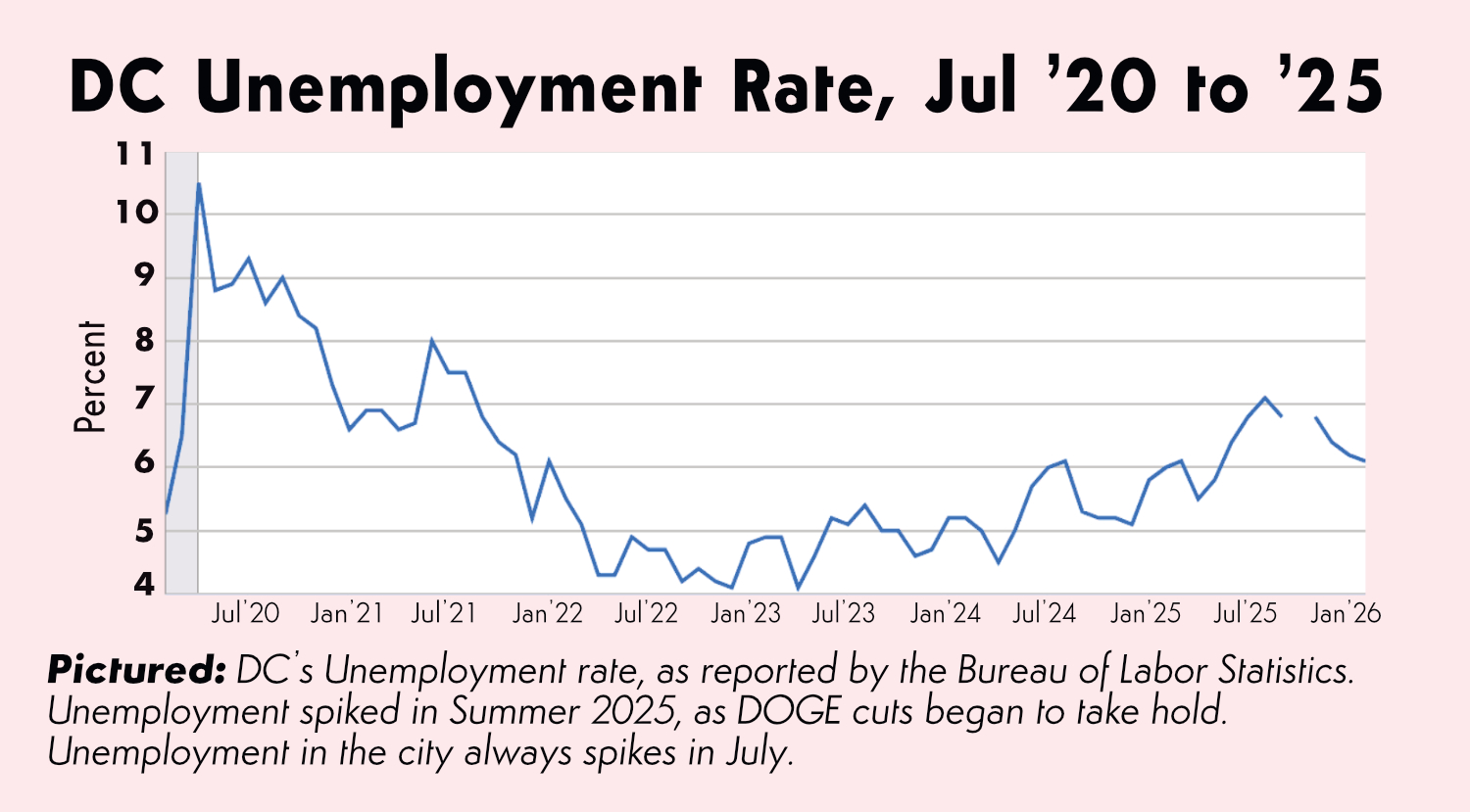
From DOGE layoffs to the longest government shutdown in history, federal workers have lived in existential crisis for nearly a year under the Trump regime, uncertain of the future of their employment. With SNAP benefits slashed, even basic groceries became out of reach for millions. The inability of federal workers, who make up 41% of the district’s working adults, and those working in adjacent industries to reliably buy groceries, let alone to dine out, has deeply impacted the restaurant industry. Increased military and police presence, as well as the government shutdown, which closed the national parks and museums that make DC so attractive, has led to a precipitous decline in tourism. An August 2025 article in the Washington Post cited a 9% decrease in sit-down dining spending compared to 2024. According to a study by the Brookings Institution, “The first year of the second Trump administration has been notably bad for visitor spending in core jurisdictions where the visitor economy is more important.”
Promises of equal pay for tipped workers were destroyed this summer, when the DC Council once again overturned the will of the people. Voters in DC overwhelmingly approved eliminating the tipped minimum wage and creating one fair and equal minimum wage for all workers, not once, but twice. First, in 2018, by passing Initiative 77 with 56% of the vote, which the DC Council repealed in a 8-to-5 majority. Then again, in 2022, voters passed Initiative 82 with a resounding 75% of the vote, reinforcing that voters understood what they were voting for. Both times, in an act of cowardice and a betrayal of democracy, the DC Council sided with RAMW to overturn the law. In 2025, seven of the District’s 12 councilmembers voted to gut Initiative 82, which would have gradually raised the tipped minimum wage (currently $10) to meet the full minimum wage (currently $17.95) by 2027, next year. Instead, the law now caps the tipped minimum wage at 75% of the full minimum wage by 2034, over the next eight years.
Despite putting the blame of operating costs squarely on labor, unrestrained rising commercial rent is a major culprit. “Unlike residential rent, commercial rent is not subject to any rent control or rent stabilization measures,” according to Washington Socialist. In a survey by RAMW, more than half of the restaurants in DC have reported higher occupancy costs since 2019, with an average increase of 18%. High rental costs have been cited as a threat by such prominent restaurants as Founding Farmers, Busboys and Poets, and Ventnor Sports Café. Indeed, rather than punishing workers by cutting wages, RAMW could have joined forces with their workers and DC’s working class to take on the real estate industry and fight for rent regulation, which would have done more to actually protect their interests.
Furthermore, the restaurant industry is still recovering from a historic global pandemic. Just five years ago, the US restaurant industry faced its greatest crisis since Prohibition. COVID-19 and its ensuing lockdown shuttered small businesses across the country, particularly those that could not transition to take-out or outdoor services. Some restaurant owners took on unsustainable debt to weather that storm. Working with their lenders to modify their loan terms now that interest rates are declining again could be a solution to that problem; balancing the books on the backs of restaurant workers is not.
Figuring out how to respond to the crisis facing service workers in D.C. requires understanding our history of struggle. The first restaurant industry union was formed in Chicago in 1866. In 1891, the Waiters and Bartenders National Union was formed, affiliated with the American Federation of Labor (AFL). They would later become the Hotel Employees and Restaurant Employees (HERE). For decades, HERE represented the vast majority of restaurant workers. In 1918, HERE membership numbered more than 65,000, but declined over 40% during Prohibition, as there were no longer any bars, bartenders, or bartender unions, due to all such businesses being illegal. Membership recovered after Prohibition was overturned in 1933. In 2004, HERE merged with the Union of Needletrades, Industrial, and Textile Employees (UNITE) to form UNITE HERE, which currently counts about 300,000 members. UNITE HERE is represented in DC by Locals 23 and 25.
In San Francisco, up until the mid-1970s, most restaurant workers were unionized. The first union in the city was the cooks’ union, but everyone from dishwashers to hosts were part of their own locals. Unions in the restaurant industry were organized citywide by profession, so if you were a waiter in San Francisco, you were in the waiters’ union. If you were a bartender, you were in the bartenders’ union.
When US manufacturing and their unions were strong, union members often chose to dine at unionized bars, restaurants and cafés, where they knew they were supporting a better product, better service, and better treatment of workers. In contrast, activists would protest non-unionized establishments by staging “sip-ins,” where they would linger for hours over a single cup of coffee. Union membership was an asset to businesses.
Union membership has been experiencing a decline since 1983, when the Bureau of Labor Statistics first began tracking it. In 2024, it hit its record low of about 10%, down from 20% in 1983. In the restaurant industry, unionization dips even lower to just 1.8%. But significant momentum has been gained nationally in recent years to organize within the food and beverage industry, which has seen successful union campaigns at Anchor Brewing in San Francisco and Voodoo Doughnut in Portland, Oregon. In 2021, Starbucks Workers United was formed in Buffalo, New York, launching a movement that would encompass over 650 Starbucks stores in the United States and represent more than 14,000 workers across 45 states and Washington, D.C. In November 2025, amid a flurry of Unfair Labor Practices charges against the company, Starbucks workers voted to strike in response to management’s continued refusal to bargain.
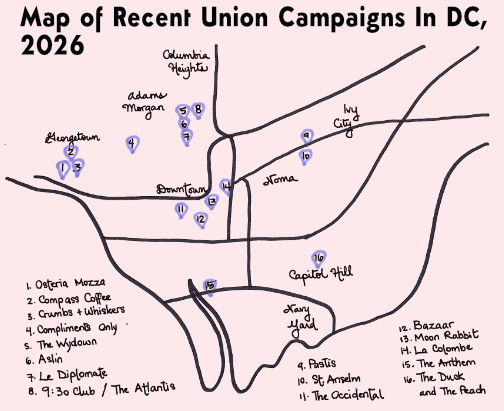
Here in DC, inspired by growing labor solidarity across the country, union campaigns sprung up across the industry and restaurant types – from cafes such as The Wydown, Compass Coffee, and La Colombe, counter-service restaurants including Compliments Only and Union Kitchen, all the way to fine dining establishments with Moon Rabbit. Not every campaign was ultimately successful, but each one contributed to a palpable shift in the industry in favor of worker power and union solidarity.
This momentum continued into January 2024, setting up a series of union fights. At The Bazaar, owned by local celebrity chef José Andres and housed in the former Trump International Hotel, workers secured voluntary recognition of their union within days of announcing their union drive. The 140 workers, including hosts, food runners, cooks, waiters, bartenders, and more, were represented by UNITE HERE Local 25. Their reasons for bargaining were for better wages, more affordable healthcare, and more transparent tip distribution policies.
Bartenders at the DC location of Aslin Beer Company unionized a month later, in February 2024, also receiving voluntary recognition from the company within days. This victory was buoyed by an outpouring of support from both the labor and brewing communities. Their stated reasons for unionizing were inconsistency and unpredictability in scheduling, understaffing, facilities in a state of disrepair, and unsafe working conditions. In particular, bartenders were forced to work without air conditioning in the summer and with indoor temperatures often exceeding 100°F. In contrast, winter shifts could mean staffing the unheated outdoor bar in near-freezing temperatures, fully bundled up in mittens and winter coats. Unionizing became a significant asset to Aslin’s DC taproom, as a constant flow of labor organizations, civil rights non-profits, and other social justice groups chose the location as their happy hour destination.
However, two years later, ownership at Aslin has still failed to negotiate a contract in good faith, forcing workers to file an Unfair Labor Practice charge, after two members of the Organizing Committee saw their hours reduced from full-time to part-time. Both were women of color, one of them a single mother, and both were among the most senior staff. In addition to a loss of hours and the resulting loss in income, management revoked benefits that accompanied full-time status. Such benefits included health insurance and paid time-off, which one of the workers routinely relied on to address a chronic illness. This action by the company was in retaliation for a set of economic proposals presented by the union. The owners rejected the proposals wholesale and, within days, reduced the workers’ hours.
In early 2025, UNITE HERE Local 25 spearheaded actions to unionize at several restaurants owned by Stephen Starr, including DC institution Le Diplomate, as well as St. Anselm and Pastis. Those restaurants now include Osteria Mozza and The Occidental. These efforts to organize have been faced with mixed results. While workers successfully voted to unionize at St. Anselm, STARR Restaurants objected to the election results, claiming union elections could not be certified while the National Labor Relations Board (NLRB) was not in quorum. Local 25 claims the company also interfered with elections at Pastis and cancelled them at Le Diplomate. For months, activists and allies have continued to picket outside Le Diplomate, even as worker and union relations soured due to disagreements in campaign tactics. Meanwhile, more than 50 Democratic members of Congress have signed a pledge to boycott it and other restaurants that continue union-busting. Those who signed on include Rep. Alexandria Ocasio-Cortez, Sens. Bernie Sanders and Elizabeth Warren, and former House Speaker Nancy Pelosi. More recently, the NLRB has filed charges against St. Anselm for alleged union-busting activity.
In December 2025, workers at the Capitol Hill restaurant Duck and The Peach, as well as its sister restaurants La Collina and The Wells announced their plans to unionize. Approximately 70% of their staff signed a petition requesting a fair process from management. Those workers are also represented by UNITE HERE Local 25.
Finally, the first few months of the year have already seen several significant union wins. In the fall of 2025, 300 workers at several DC music venues owned by IMP, including The Anthem, The Atlantis, Lincoln Theatre, and the iconic 9:30 Club, moved to unionize. They listed inconsistent schedules, low wages, lack of hazard pay and health insurance, and juggling multiple jobs as their reasons. In April 2026, workers represented by UNITE HERE Local 25 (door staff, kitchen, hospitality, and bar) celebrated a tremendous victory when they voted 107-0 to ratify their contract. Among other things, it would grant workers 20-25% raises over the 3 years of the contract, expanded overtime and healthcare eligibility, just cause protections, a fair and consistent attendance policy, fair scheduling guarantees, bereavement leave, holiday pay and 80 hours of PTO for an expanded pool of full-time workers. Their co-workers represented by IATSE (box office and production) are still bargaining.
In January 2026, workers at a cat café in Georgetown, Crumbs & Whiskers, announced their intent to unionize. A month later, their owner closed the business “until further notice,” putting the staff of a dozen out of a job effective immediately. However, in one of the few labor victories of the past year, Crumbs & Whiskers re-opened in March with a unionized staff.
A study by the Economic Policy Institute (EPI) found that nearly 17% of restaurant workers live below the poverty line (compared to 6% of workers outside the restaurant industry). More than 40% cannot make ends meet. That same study exposed the many inequities that restaurant workers face compared to workers in every other industry. Most obviously, federally and in most states, restaurant workers are subject to a sub-minimum wage, thereby reducing their average pay compared to workers in other industries. Originally set at 50% of the federal minimum wage in the 1960s and raised to 60% in the 1980s, the federal tipped minimum has been frozen at $2.13 per hour since 1996, despite increases in the federal minimum wage for non-tipped workers between 2007 and 2009.
In California, in 1988, the state Supreme Court struck down the tipped minimum wage as unconstitutional. It was the first state in the country to eliminate the tipped minimum wage. Currently, there are seven states that no longer have a tipped minimum wage. These states are Alaska, California, Minnesota, Montana, Nevada, Oregon, and Washington.
Within the widely unorganized restaurant industry, unionized workers receive substantially better wages than their non-unionized peers, making nearly 25% more hourly. Furthermore, poverty rates are lower among unionized workers, and unionized workers are nearly three times more likely to receive health insurance and roughly four times more likely to receive a pension plan.
To support improved working conditions for restaurant workers, organizers and allies must advocate for the following legislative action:
In addition, we as workers can engage in collective action and organizing that goes beyond unionizing, such as shift-sharing, mutual aid funds, public pressure campaigns, neighborhood watch groups, distributing Know Your Rights materials in different languages, and protecting immigrant co-workers and workers of color.
In the restaurant industry, we strive every day to provide our guests with comfort, a place to meet in community, a memorable experience, and a respite from their daily lives. Our labor is the labor of service, of hospitality, of care. We, the workers, are the service industry--not the owners.
We must fight for what we deserve.
---
This article originally appeared in EXPO Magazine, a print publication serving DC service industry workers.


