
SINCE 2022, the Palestinian Boycott, Divestment, Sanctions (BDS) National Committee has called for the boycott of and divestment from Chevron due to the corporation’s complicity in Israeli apartheid. Chevron is the primary fossil fuel extractor for Israel in the Eastern Mediterranean Sea, paying Israel hundreds of millions of dollars annually for extraction licenses, thus financing its war machine and apartheid regime.
The DSA joined the global campaign targeting Chevron in 2024 with its #StopFuelingGenocide campaign, with a focus on building consumer boycotts and targeting Chevron’s sponsorships. Since the launch of #StopFuelingGenocide, the campaign has experienced successes and setbacks. With Chevron still operating in Israel, this fight against genocide continues.
Chevron first entered the Israeli market in 2020 with the acquisition of Noble Energy, which owned nearly 200,000 acres of natural gas reserves offshore occupied Palestine and now controls most of Israel’s fossil gas production. Through its partial ownership and operation of the Tamar and Leviathan gas fields in the Mediterranean Sea, Chevron supplies 70% of Israel’s energy consumption needs for electricity generation, some of which powers military bases, prisons, and illegal settlements. The Tamar gas field is of particular material value to Israeli occupation: it holds the main supply contract for the state-owned Israel Electric Corporation, which in turn uses that gas to generate and supply electricity for the Israeli regime to use as a tool of oppression. The Israeli government weaponizes this partnership to deny some Palestinian villages in the West Bank access to the power grid, while charging others high and unpredictable usage rates for inferior service compared to what nearby Jewish settlements enjoy.
Chevron’s operations have also restricted Gaza’s access to its own waters. Since 2007, Israel has imposed a complete air, land, and naval blockade of Gaza, partially to enable and escalate natural gas extraction operations off the region’s coast Subsequently, the Israeli Navy secured the Tamar oil processing rig, located right outside the territorial waters of Gaza, by restricting all Palestinian maritime activities nearby. By 2023, Israel had tightened its naval blockade to just 3-6 nautical miles offshore, which devastated Gaza’s once-thriving fishing industry and economy leading up to the present escalation of genocide. Now, Chevron owns these processing facilities, enabling full Israeli siege of Gaza for environmental exploitation and profit.
The BDS movement’s boycott of Chevron is modeled after the 1980s anti-apartheid campaign against Shell in apartheid South Africa. Conditions for Black South Africans were very similar to conditions for Palestinians today: they, along with other non-white populations, were denied access to electricity and running water, and forced to live in settlements far from urban centers, where their labor benefited the white population. In February 1985, workers at the Rietspruit coal mine, half-owned by Royal Dutch Shell, went on strike after the death of a worker. This sparked an international boycott of Shell, led jointly by anti-apartheid activists and prominent labor groups, including United Auto Workers (UAW). These boycotts and demonstrations across the US and Europe drew attention to the crucial role of oil in fueling the South African economy and how oil companies in turn profited from apartheid.
The national #StopFuelingGenocide campaign has three main strategies: picketing gas stations, convincing gas station owners to drop the Chevron brand, and pressuring local organizations and events to drop their Chevron sponsorships and partnerships. Despite their lack of gas stations in the mid-Atlantic region, Chevron still has a presence in the DC area, including a government affairs office downtown and several local institutions they sponsor or hold partnership with, such as DC’s National Cherry Blossom Festival, Ford’s Theater, and the University of Maryland.
Metro DC DSA has focused efforts on increasing public awareness of and engagement with the boycott and sponsorship drop campaigns. In January 2025, we kicked off our local campaign with a teach-in and panel discussion on Chevron’s role not only in Israeli apartheid, but in climate disasters all over the world. BDS activists from Palestinian Youth Movement (PYM), Jewish Voice for Peace (JVP), and DC for Palestine, joined us to discuss the importance of local boycotts and divestment efforts. That same week, we protested outside the Chevron Government Affairs office, which was later a stop on our May 2025 Palestine Solidarity walking tour, to commemorate Nakba Week.
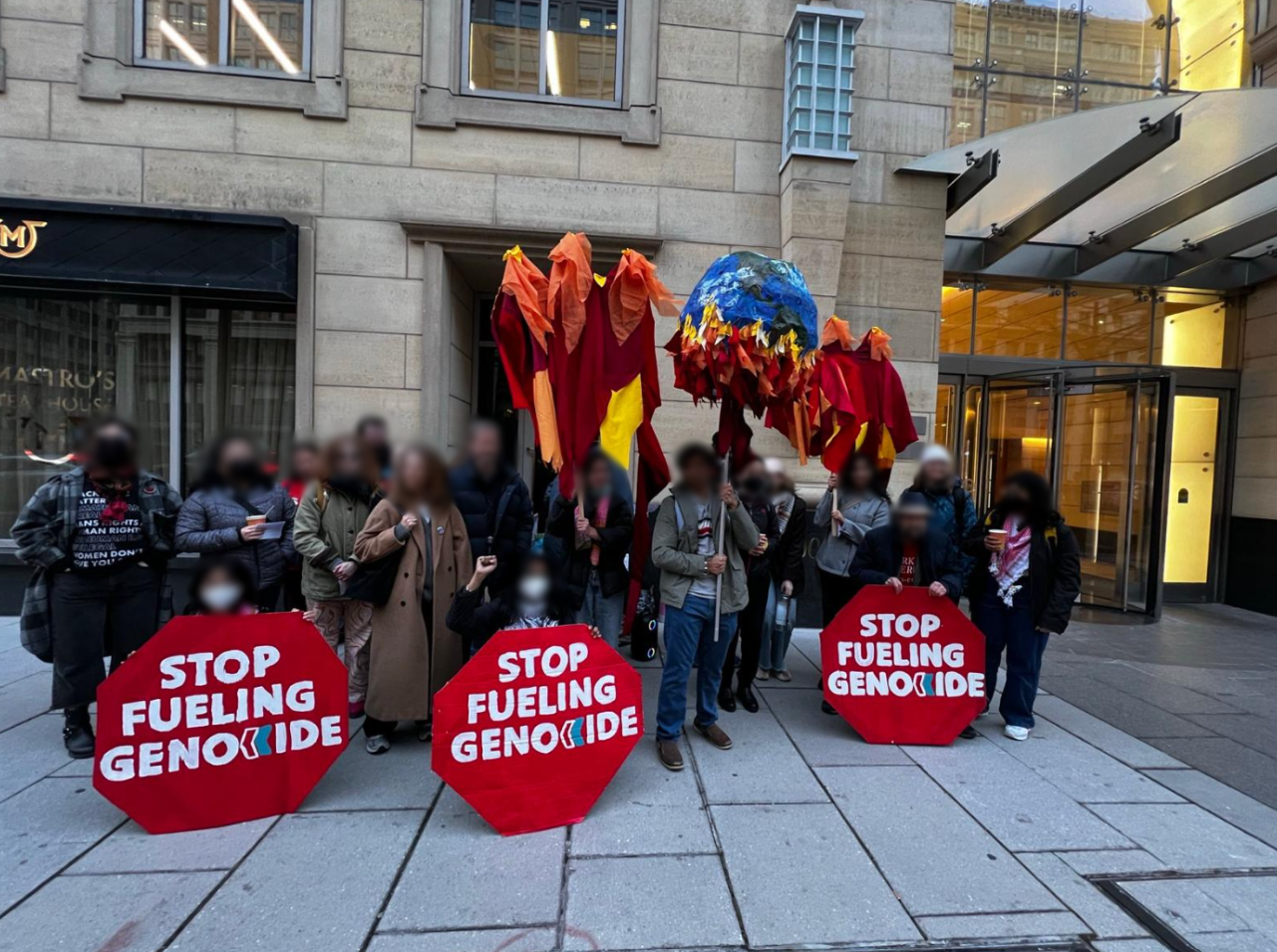
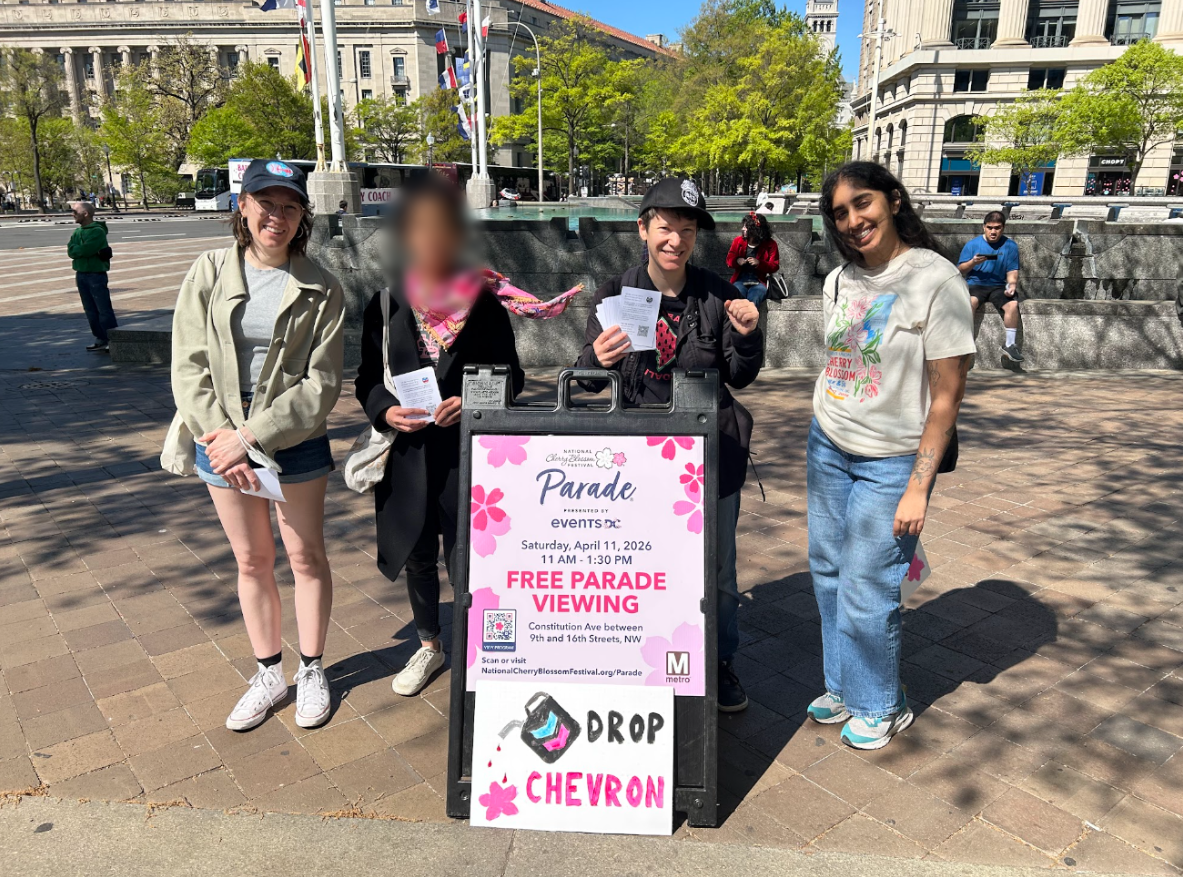
This year, we launched a campaign to pressure the National Cherry Blossom Festival to drop Chevron as a sponsor. Our petition garnered over 800 signatures leading up to and during this year’s festival. At one of its most-attended events, the Kite Festival on the National Mall, we passed out Palestine-themed kites and were generally met with positive reactions from festival-goers, who initially had no idea that Chevron was a sponsor of the festival. While flyering to publicize the petition — with one of our members dressed as Netanyahu — we were told by festival staff multiple times to leave park grounds.
A few weeks after the festival, we delivered our petition to the National Cherry Blossom Festival administrative office. Despite several emails and calls, we failed to get a scheduled meeting with their admin team. However, with a bit of social engineering and help from partner organizations, including Franciscan Action Network, the Vice President of the festival, Lillian Iversen, came down to the building lobby to speak with us. We handed her the petition and requested a meeting with the team to discuss their sponsorship strategies. The encounter was brief but encouraging, and we were hopeful we would at least get a virtual meeting scheduled. Unfortunately, we have not heard back since.
Interestingly, the festival quietly removed Chevron from the “2026 sponsors” section on their website sometime in early July. We have since been unable to get confirmation directly from the festival’s organizers on whether they’ve dropped Chevron as a sponsor going forward, but the sponsor page on their website was updated in October to “2027 Sponsors”, and Chevron is not listed!
The Cherry Blossom Festival has been largely uncooperative with Metro DC DSA and our partner organizations, but we remain hopeful. Several other sponsorship drop campaigns across the country have been successful. Our comrades in Denver DSA have successfully pressured the Denver Marathon, the Colfax Center, and most recently the Denver Zoo to drop Chevron as a sponsor. Other successful sponsorship drop campaigns include the California State Fair and the New Orleans French Quarter Festival. Additionally, DSA members have convinced several Chevron franchise owners to sign a letter demanding Chevron end its business in Israel.
Chevron has repeatedly had to shut down operations in Israel since October 2023. In March of this year, the Leviathan gas field closed for 32 days due to Israel’s war with Iran. Despite this uncertainty, a recent report from Israel’s Dayan Committee indicates that Chevron's ownership of the Tamar and Leviathan fields will continue and Israel has no intentions of cutting ties.
At Chevron’s 2026 shareholder meeting, a proposal to “commission a third-party report on human rights processes” was brought forward for consideration. The proposal specifically highlighted Chevron’s “[contribution] to and benefit from systemic violence and atrocity crimes” in the occupied Palestinian territories. The Anti-Defamation League (ADL) and JLens argued that the proposal targeted Chevron’s Israel-linked operations and urged shareholders to vote it down. The proposal was ultimately rejected, with 9% of votes cast in support.
---
Two years on from its launch, the Stop Fueling Genocide is still active and growing, with various DSA chapters and grassroots partners across the US meeting on a monthly basis to discuss experiences and strategies. Targeting sponsorships remains a popular strategy — two recent campaigns are urging the Texas Rattlers bull-riding team and the LA Football Club to drop Chevron as a sponsor. As public awareness of Chevron’s ties to genocide grows, DSA plans to maintain pressure until we can win, for both Palestine and the planet.


