
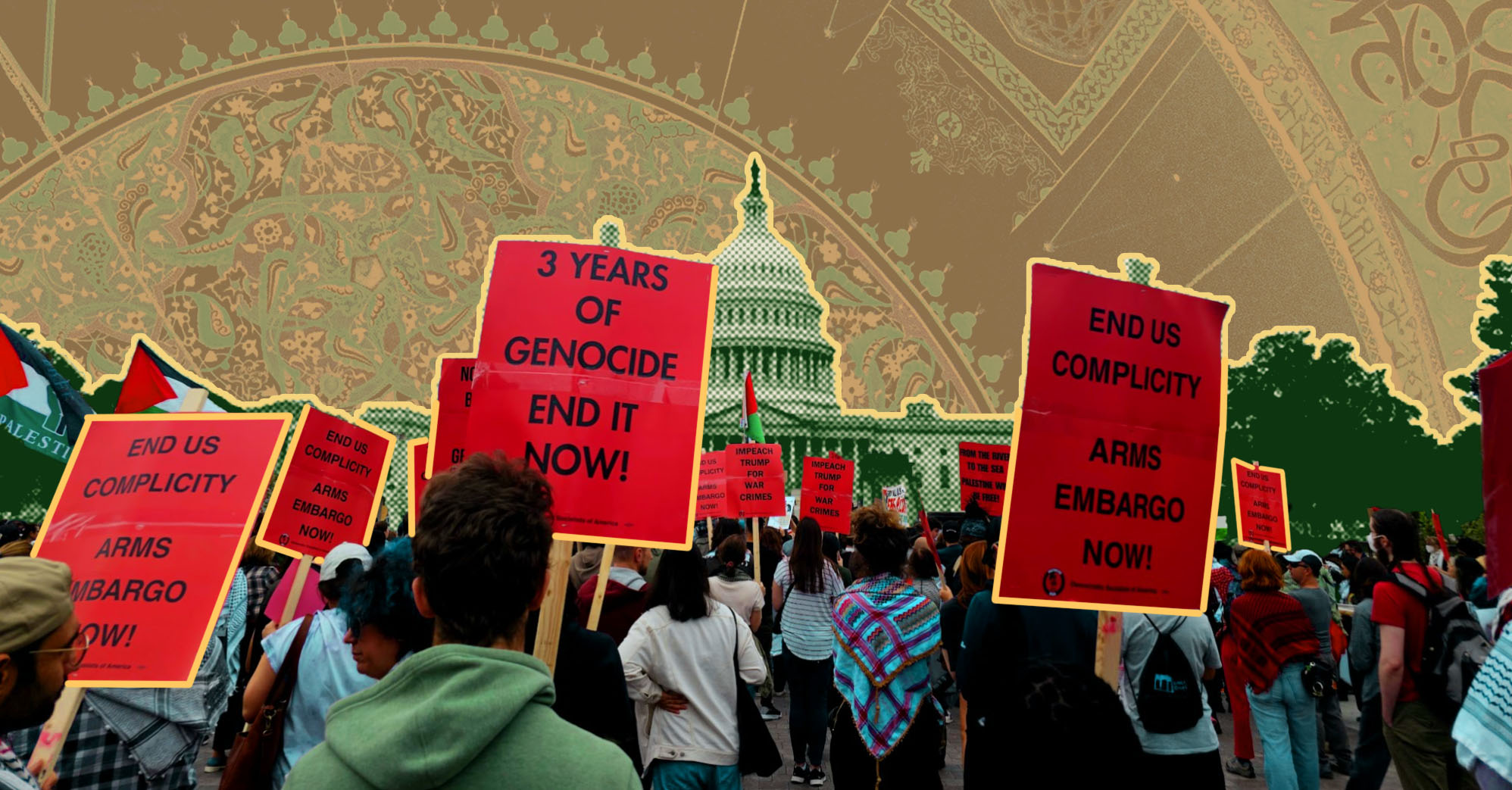
“In newsreels or news-photos, the Arab is always shown in large numbers. No individuality, no personal characteristics or experiences. Most of the pictures represent mass rage and misery, or irrational (hence hopelessly eccentric) gestures. Lurking behind all of these images is the menace of jihad. Consequence: a fear that the Muslims (or Arabs) will take over the world.”
— Edward Said, Orientalism (1978)
Abdul El-Sayed’s Provocative Electoral Upset
This election cycle, Dr. Abdul El-Sayed made history as the first ever Muslim Senator-elect, his progressive campaign platform claiming victory first over moderate incumbent Haley Stevens in the July Democratic primary election, then over Republican Mike Rogers in the November race. Despite just skirting by in the primaries with a razor-thin 0.8% lead against Stevens, El-Sayed won the general election with a comfortable 7% lead over Rogers (1, 2).
Although El-Sayed himself asserts he’s “not a socialist, … just a capitalist who understands how capitalism works,” many on the left nonetheless consider him a crucial ally for his shared commitment to instituting single-payer healthcare, abolishing ICE, ending the genocide in Palestine, and more (3, 4, 5). Accordingly, his ascent to Senate is more than just a one-off grassroots progressive’s triumph over unprincipled institutionalist cronies. It is one of many major material blows to corporate-puppeteered politics.
El-Sayed won against $154 million in outside corporate and PAC funding opposing his campaign (6). AIPAC and its affiliates contributed a substantial portion of this money. They spent $30+ million backing Stevens in the primaries, then a reported $9 million backing Rogers in the general election by privately shuttling this money through the right-wing Great Lakes Conservative Fund in the final two weeks of the campaign (7, 8, 9, 10).
This dynamic echoes across the country, as midterms results collectively reveal that support for Israel has at long last become a losing policy. Across party lines, populist fervor against its genocide in Palestine — as well as the unlawful war it has pushed the US to wage on Iran — fueled this year’s “Blue Tsunami” (11). Even Vice President JD Vance admitted in a Tweet that US support of Israel, war on Iran, and the resulting economic crisis at home shaped election outcomes (12). Unsurprisingly, of the $84+ million AIPAC spent on this year’s elections nationwide, over two-thirds of that funding supported candidates who ultimately lost their races (13).
El-Sayed’s victory further represents growing pushback against the Islamophobia that has dominated American policy since the end of the Cold War. The final weeks of campaigning for both the primary and general elections saw a surge in official campaign messaging, PAC advertisements, and pundits and electeds across the political spectrum hurling unevidenced allegations of sexism and ties to groups the US recognizes as foreign terrorist organizations, relying on and in turn exacerbating Islamophobic stereotypes. Several sources have since debunked these claims, but prominent examples are worth revisiting.
During the primaries, AIPAC’s shell super PAC, United Democracy Project, spent $25+ million on advertisements, such as this one falsely claiming El-Sayed is “disrespecting women” (14, 15).
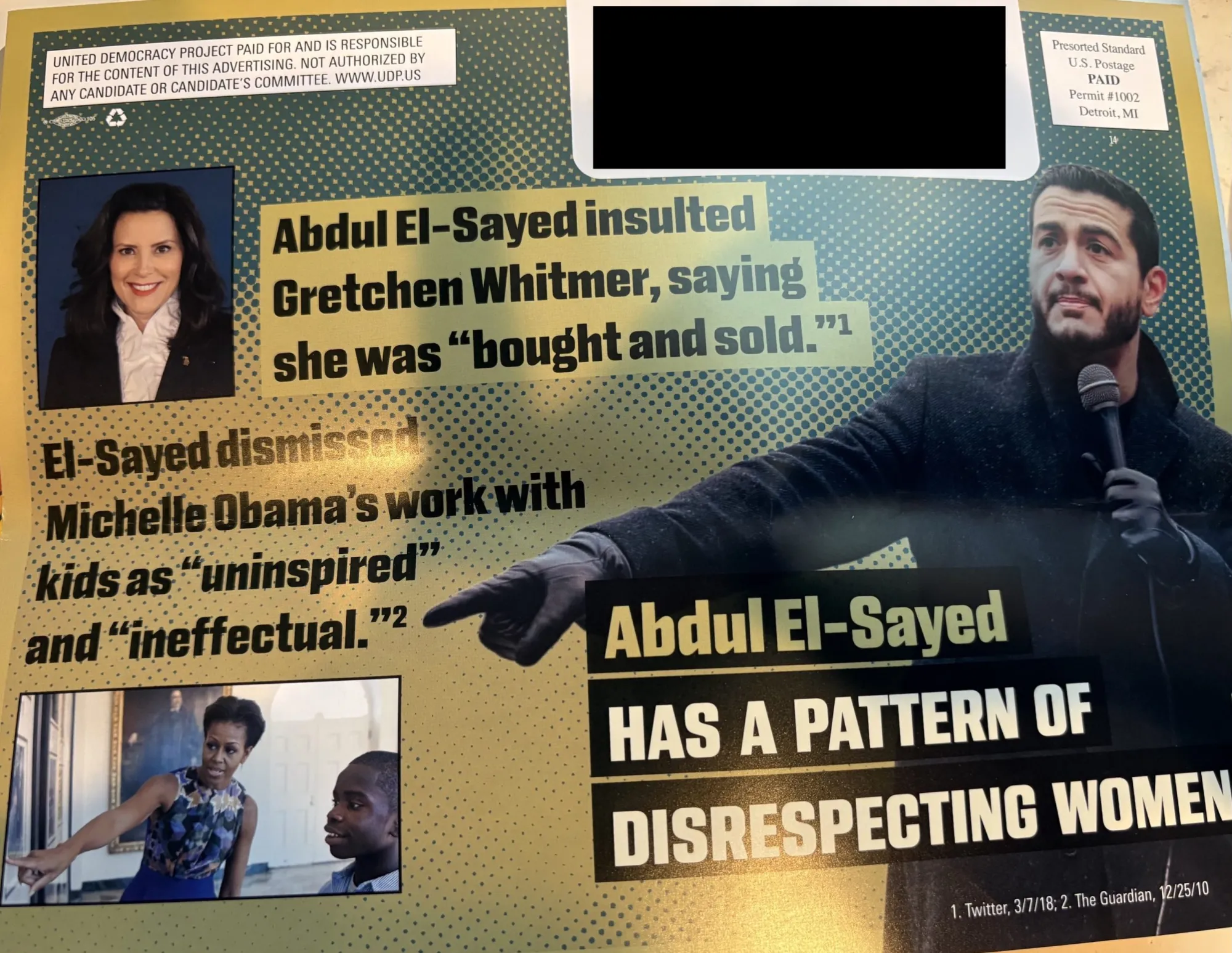
On CNN, Michigan House Democrat Hillary Scholten leveraged her sway over voters during primaries to assert there was a “uniquely sexist bent to the things [El-Sayed] has said about women,” referencing some of the same since-fact-checked quotes from the above flyer (16). Even in the general election, she did not campaign for or endorse him against Rogers (17).
Neera Tanden — veteran Democratic political consultant, former advisor to Biden, and close personal friend to the Clintons — has similarly dedicated her rank in the party to villainizing El-Sayed. She compared him to Maine’s Graham Platner, now disgraced for committing sexual assault, implying their shared populist platform translates into shared misogynist sentiment, that El-Sayed is also anti-woman (18, 19). Tanden has also fixated on El-Sayed’s alliance with left-wing political commentator Hasan Piker, even showing support online for far-right conspiracy theorist Laura Loomer’s comments on the matter (though she has since claimed her retweet of Loomer’s Islamophobic post was “mistaken”) (20, 21, 22, 23, 24).
Tanden’s sweeping efforts to portray El-Sayed as a misogynist, affiliate of a sexual assaulter, and radical unfit for Senatorship hinge on his identity as a man who is (or even looks) Muslim. (Although she begrudgingly endorsed him in the general election, she did little to substantiate the verbal alignment with action.) Within her liberal-friendly feminist rhetoric, however, lies immense hypocrisy: this same fiery feminism disintegrates within her friendship with the Clintons, affiliates of the Epstein class of actual misogynists, pedophiles, and rapists of the most depraved order (25, 26, 27).
In the general elections, Republicans deployed more blatantly Islamophobic rhetoric in their attempt to smear El-Sayed. The AIPAC-funded Great Lakes Conservative Fund ran television ads aiming to link El-Sayed, with his Muslim Egyptian background, to the Muslim Brotherhood (which the US designates a foreign terrorist organization), while Texas Senator Ted Cruz called him a “jihadist leprechaun” (28, 29). Notably, such attacks are contingent on and further reinforce pre-existing connections in the American mind between Islam as a faith and terrorism as violence, falsely portraying the former to inherently entail the latter.
These attacks — born from the intersection of Islamophobia, xenophobia, and racism — also target other visibly Muslim politicians such as Zohran Mamdani, Ilhan Omar, and Rashida Tlaib, and with the same false claims that their religious and ethnic backgrounds are irreconcilable with American values. This style of smear campaign and heightened vulnerability to racialized monolithization certainly isn’t new or coincidental, but one conforming to a decades-old, institutionally manufactured illusion of what a Muslim should look, talk, and act like.
Orientalism, Abridged
Coined by postcolonial scholar Edward Said, Orientalism is a catch-all description of these understandings that the “West” has long held of the “Orient,” an outdated term referring to regions spanning from North-Central Africa to East Asia. Orientalist thought portrayed those across the entire Orient as culturally, intellectually, and physiologically inferior to those of the West. As such, the West had a moral responsibility to intervene and “civilize” them, contributing to the ideological foundations of the mass European conquests of Africa and Asia defining the 18th-20th centuries (30).
Orientalism remains the foundation of mainstream stereotypes of the entire East, although it has more recently (since the Cold War and especially since 9/11) focused on Muslim-majority regions: North and East Africa, Southwest Asia, and South Asia. The relevant tenants of Orientalist ideology can be summarized as such:
Such framing of Muslim/-ish individuals took root over the second half of the 20th century, as ever-escalating destabilization across the Middle East and North and East Africa — largely due to violent interventions from Israel and other US-backed regimes — brought the region to the periphery of Western consciousness. 9/11 further dragged it to the center, compounding premature notions of Oriental underdevelopment with a reeling nation’s feverish vulnerability and hyperpatriotism to conceive a bloodthirsty desire for protection and vengeance.
These sentiments manufactured consent for immediate transformations in American policy and culture. In foreign policy, they gave way to the “War on Terror,” horrors of Abu Ghraib, and displacement of tens of millions across the so-called Orient. In domestic policy, they led to increased securitization, surveillance, and militant policing that disproportionately targeted communities of color. In everyday life, they normalized violence: from 2000 to 2001, there was a 1600+% increase in hate crimes against Muslim/-ish individuals (31). To the well-meaning patriot, such were necessary prerequisites to preventing future attacks on American soil and bestowing Western liberalization upon the oppressed and oppressive.
That immediate post-9/11 spike in racially charged violence still defines contemporary sociopolitics. The years of Trump’s first presidency, as well as the beginning of this escalation of Israel’s genocide of Palestine, have escalated discrimination and violence against Muslim/-ish individuals to 9/11 levels (31, 32, 33, 34). From anonymous Twitter pages to the President, all have full amnesty in espousing rhetoric that neglects, dehumanizes, and harms Muslim/-ish individuals because they do so as part of a system that codifies these sentiments into reality. This is both a cause and effect of overt Orientalist ideology.
Approaching Three (and 75) Years of Genocide
The Orientalist thought that enables the attempted character assassinations of El-Sayed and other high-profile Muslim/-ish politicians is the same Orientalist thought that provides ideological justification and material support for the ongoing genocide of Palestine, of which we just crossed the three-year anniversary. Orientalism recognizes no individualized ethnicity or hyphenated identity or politically correct worldview in its quest to reign destruction upon the Oriental “other” it constructs into a villain.
An in-depth review of the entire past three years of ethnic cleansing would take days to read and weeks to compile. Instead, I point to Archive Genocide’s records of the Zionist occupation’s horrific crimes against Palestinians (35). Similarly, for more on the origins of this genocide, which began decades before October 2023, I point to academic works such as Edward Said’s The Question of Palestine, Nur Masalha’s A Land Without a People: Israel, Transfer and the Palestinians 1949-96, Ilan Pappe’s The Ethnic Cleansing of Palestine, and Rashid Khalidi’s The Hundred Years’ War on Palestine.
It is, however, worth re-evaluating Western coverage of Palestine in the immediate aftermath of October 7th, as mainstream media blasted unverified headlines that amplified claims of Hamas — Gaza’s ruling political party with a paramilitary wing — committing atrocities. These early reports, since confirmed to have been false, were crucial in shaping Americans’ initial support for Israel, even amidst its disproportionately violent retribution.
In fact, with the Zionist regime, every accusation turns out to be a confession. For instance, an Israeli journalist’s October 10 social media post claimed Israeli babies had their heads cut off — within 24 hours, Western headlines ran that Hamas had beheaded 40 Israeli babies (36, 37). Democratic and Republican lawmakers alike, including then-President Joe Biden, echoed this statistic to justify their condemnations of Hamas and unwavering support for Israel (38). Under the cover of this imagined violence, real Israeli onslaught was already cutting off power to Gaza’s hospitals, murdering dozens of NICU infants without the same Western news attention or sympathy (39, 40, 41, 42).
The Israeli government’s subsequent disinformation campaign claimed Hamas used Gaza’s Al-Shifa Hospital as their headquarters, again despite credible evidence. Although also false, it successfully redirected the West’s attention away from Israel’s concurrent strikes and carpet-bombings of Gaza’s schools, hospitals, and refugee camps, which killed 13,000+ in under one month (43, 44). Simultaneously, they stoked claims that Hamas used Palestinian civilians as human shields.
Sensational without substance, Zionist propagandists and their Western partners in war crimes designed these headlines to overwhelm Western consumers, masking the fact that Israel intentionally placed its military headquarters in a civilian district of occupied Tel Aviv to shield it from potential attacks, and that Israeli soldiers have used Palestinians as human shields for decades (45, 46, 47). In all of these instances and more, Israeli forces commit the same depraved, barbaric violence of which they accuse Palestinains, consolidating the West’s dehumanization of Palestine and acceptance of genocide.
Despite their absurdity, Western headlines were successful in manufacturing early consent for genocide with little criticism because they reinforced pre-existing Orientalist tropes: Muslim/-ish individuals are barbaric and brutish — of course they behead babies, co-opt hospitals, and use their own as human shields. Those of the civilized West would never stoop so low.
This violence continues despite (or because of) the “ceasefire” in effect since October 2025, which is only the most recent since October 2023. Under the guise of this ceasefire, arranged and overseen by the Trump-engineered “Board of Peace” — a hand-picked collection of warhawk politicians and corporate technocrats — well-meaning liberals can reconcile receding into their own bubbles of comfort with their attenuated moral instincts (48). After all, a ceasefire on paper must mean an end to the violence in practice. This false comfort, alongside the fact that Israeli occupation forces have assassinated nearly all journalists and heavily restricted internet access in Gaza, leads to significantly reduced coverage of ongoing violence.
In reality, Zionist forces have violated the terms of the current ceasefire over 1,000 times, killing 1,200+ Palestinians and injuring 4,000+ more (49, 50). Even these figures are extreme undercounts because the occupation has systematically destroyed all civilian infrastructure needed to track these metrics (51). This parallels ongoing strikes on civilian targets: cafes, low-capacity hospitals, and even a funeral for 112 members of the same family (52, 53, 54, 55). Zionist forces now brand Palestinian detainees with numbers, in yet another alarming echo of Nazi violence during the Holocaust (56, 57). They continue to restrict aid to Gaza, prolonging the famine they manufactured, and block Palestinian prisoners from receiving vital medical care (58, 59). Zionist and collaborationist forces also kidnap, torture, and murder healthcare workers: they’ve held neonatologist and hospital director Dr. Hussam Abu Safiya under deadly conditions since December 2024, and kidnapped gynecologist Dr. Dima Amin from her home in the Occupied West Bank this summer, reminding us that genocide of Gaza and settler-colonial violence in the West Bank are concurrent and intertwined (60, 61).
The sustained onslaught, as well as Trump’s Board of Peace, has pressured Hamas to agree to surrender arms in exchange for the complete withdrawal of Zionist forces. They now look to consolidate political power through a once-unthinkable series of political alliances with other factions leading up to Palestine’s elections, initially set for this month but postponed at the last minute to next year. (62, 63, 64, 65). Whether either of these developments will grant long-overdue reprieve to Palestinians remains unknown, especially as Israel has yet to agree.
Amidst the visceral and temporal permanence of sinful genocide descrating the holiest of lands, it is impossible to sufficiently center the lives and stories of every injured and killed Palestinian who, like us, has family members and best friends and professional aspirations and favorite things, and that only sheer geographic luck keeps our lives from looking like theirs and their lives from looking like ours. Simultaneously, it is impossible to sufficiently combat the numbness creeping into our bones from spending every day of the last three years scrolling through headline after headline on new forms and magnitudes of depravity and devastation.
Electoral Politics in an Era of Genocide
Over the last three years, public sentiment has shifted to acknowledge the extent of the atrocities Palestine has long faced. The West finally has enough evidence to free itself from Orientalism’s decades-long chokehold on policy, education, and everyday life. However, this evidence comes at an immense human toll: in those last three years alone, Gaza lost an estimated 680,000 lives, nearly a third of its population (51, 66, 67). (Though this staggering figure is not one mainstream media cites, it is one epidemiological methods substantiate and even UN Special Rapporteur Francesca Albanese has adopted). Palestine became the “correct” side to support only once there was little Palestine left to support at all.
Even then, much of this newfound support stems not from delayed moral awakening or commitment to collective liberation, but from a desire to alleviate direct personal damage. As the Trump/Epstein ruling class’s tariffs and unlawful war on Iran wreak havoc upon the global supply chain, the working-class in the West feel for themselves a fraction of the immense material harm their overlords have long been unleashing abroad, especially against Palestine. They channel some of their revolt into the polls, voting overwhelmingly for anti-war politicians who, for the most part, also happen to be anti-genocide.
For those of us organizing at the heart of the imperial core, Palestinian liberation should be non-negotiable in progressive ideology, inextricable from liberation of any other oppressed group, both at home and elsewhere abroad. The ruling members of the Epstein class who benefit from the genocide of Palestine also benefit from their corporate excesses and exploitation of the working class in America. Our freedom is materially equivalent to Palestinian freedom; compromise on the latter guarantees failure of the former.
We watch this play out with the gradual decline of “Progressive Except Palestine” electeds. Representative Ro Khanna, a Democrat outspoken against the genocide of Gaza and occupation of the West Bank, visited the latter earlier this year, was detained by Occupation Forces on camera, and still returned home disapproving a full arms embargo against Israel (68, 69). Early polling data disfavors any ambitions he may have for capturing the White House, and his “defensive” rhetoric further repels any support from the left (70).
Similarly, despite partial recognition of the devastation of Palestine, Mallory McMorrow, who ran against El-Sayed and Stevens in the Democratic primaries, maintained support for funding Israeli “defense” systems (71). Stranded in ideological limbo between El-Sayed’s progressivism and Stevens’ centrism, she lacked a cohesive base and ended her campaign early. As newly awakened and veteran leftists alike increasingly realize, Progressive Except Palestine has never been a truly progressive stance.
Upcoming progressive electeds (and hopefuls) must learn from these cases: any compromise on Palestine is an irreconcilable strategic and moral failure. It is on them as figures in power to maintain and further consolidate this line. It is on us as constituents and organizers to hold them accountable, pushing them to expand their progressivism and wield their popularity to publicly bolster our platform, not admonish it just to consolidate their own institutional legitimacy and power, lest they tumble down the Khanna/McMorrow pipeline into their political graves.
And yet, we watch some of our own electeds increasingly do just that. We still watch fellow organizers normalize and defend progressive hesitance on Palestine, relaying a resounding warning to their fellow community members, organizers, and voters of Palestinian and Muslim/-ish backgrounds: we’re comfortable with sacrificing you to achieve our other political goals. We’re comfortable with supporting politicians who peddle rhetoric legitimizing the statehood of a rogue regime and promote legislation materially enabling that regime’s slaughter of people who look like you, talk like you, comprise your family and community members, and could be you if you were there and not here. We’re comfortable with degrading you to a political afterthought.
To continue supporting and platforming such electeds after they leave us behind is to not only engage in a public humiliation ritual of our political organizations, but to turn on other progressives who prioritize principle and platform over personality. These affordances decalibrate our moral compass and redirect our trajectory rightward to operate parallel to the very Democratic Party we disparage for their harmful capitulations to the right and self-identification as the just-barely-lesser-evil.
Palestinian liberation didn’t become the socially “correct” stance through its advocates policing their language, politics, and actions to coddle the comfort of liberals and elites, but by challenging social conventions, archaic legislation, and illusions of privilege. To transform the rhetoric of popular support into action, we must continue dismantling socially constructed limits of the acceptable. Only then will we see an end to genocide, an end to American complicitness in it and countless other horrors, and a free Palestine within our lifetimes.
As always—
. حتى الحرية
Until liberation.
Iqra A is a member of MDC DSA. Views and opinions her own.


