
Kurt Stand is a longtime member of Metro DC DSA.
IN 1965, THE UNITED STATES began a full scale war against Vietnam. In 1975, Vietnamese reunification and full national independence was achieved. The lesson of the futility of that war was never absorbed by US policymakers. The impulse for domination driven by the insatiable quest for ever more wealth and profit continues unabated — witness the current war waged against Iran, against immigrant communities.
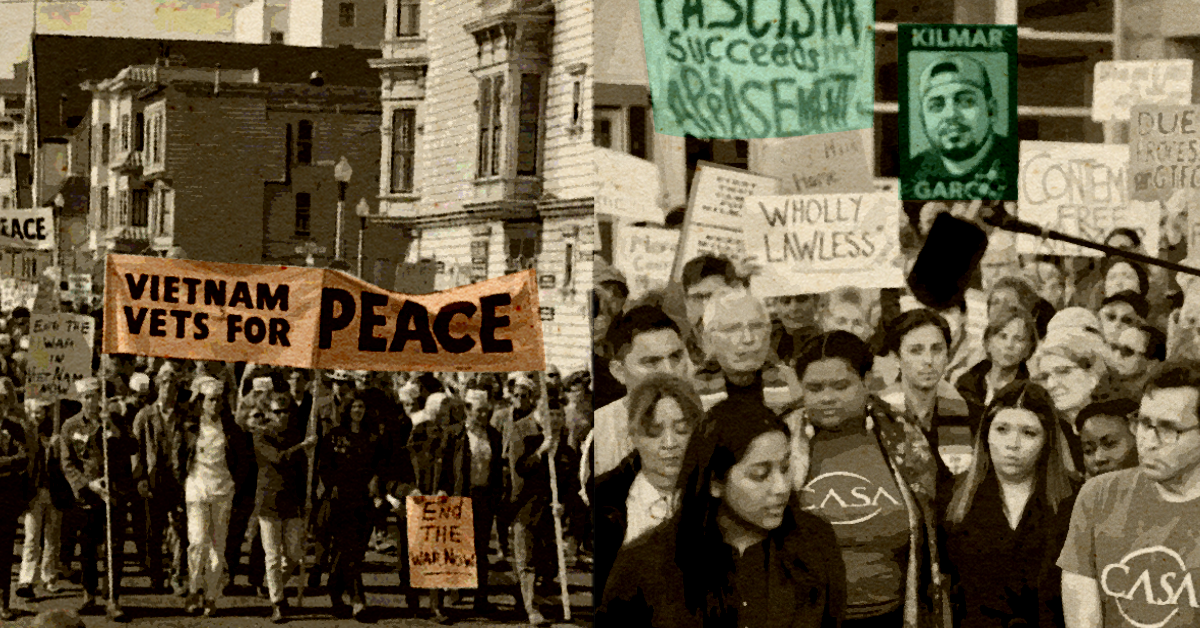
Yet where there is repression, there is resistance. And that resistance survives because it is rooted in the human desire for connection and community, the human ability to heal, to learn, to build. Three Washington, DC, events have remind us of choices people have made in the past and need to make today to overcome the intertwined evils of war and social injustice.
Trump is not the first president to violate national and international law when it comes to military action, and today’s soldiers are not the first given orders that (should) violate their sense of morality. Two members of the Armed Forces who followed their conscience and refused orders during the Vietnam War — Bob Chenoweth and Susan Schnall — showed us what is possible.
Schnall, a Navy nurse, began questioning the war while patching up its victims at an Army hospital in Oakland. The screams of pain by wounded soldiers led her to question why — why the death and destruction? The fact that she lost her father — whom she never knew — in combat during World War II served as further impetus to speak out against the Vietnam War.
Schnall decided to act in October 1968, when a “GI and Veterans March for Peace” was being organized in San Francisco. She and a friend rented a small plane and dropped thousands of leaflets over the five military bases in the Bay Area, calling on active-duty soldiers to join the protest. Schnall was given a direct order prohibiting her from addressing the anti-war march while in uniform. She disregarded the order, spoke while in uniform at the rally, then was “rewarded” by being court-martialed and sentenced to six months’ hard labor.
Yet that did not deter her. Schnall remains active to this day as part of the national organization Veterans for Peace. In her remarks at a VFP-sponsored event at Busboys and Poets in Washington, DC, on February 8, 2026, she spoke of a friend who died prematurely of cancer — one of many who suffered from illness after the war — noting that GIs who fought in Vietnam were exposed to Agent Orange.
A chemical defoliant US airplanes sprayed throughout the Vietnamese countryside to kill crops and destroy villages, Agent Orange is a form of germ warfare that is illegal under the Geneva Conventions. Nonetheless, the Pentagon used it under both the Johnson and Nixon administrations. The impact on US soldiers and their children is heartbreaking; the impact on Vietnamese children — horrendous birth defects — is almost beyond comprehension. The US government’s law-breaking was never called to account by the courts.
Thus Schnall’s message: soldiers have the right and obligation to disobey illegal orders when those orders entail violations of human rights. Ultimately, the disease that must be overcome is the disease of a society that sends people abroad to kill.
Schnall’s radicalization developed when treating soldiers coming home from Vietnam; Chenoweth experienced the horrors of combat first-hand. His helicopter was shot down on February 8, 1968, partway through his second tour of duty in Vietnam. Although most people celebrate the day of their release from prison, he celebrates the day of his capture, proclaiming that day his new “birthday.” Chenoweth explained how becoming a prisoner of war opened his eyes to the terror our country was perpetrating — and opened his eyes to the humanity of the Vietnamese people, their history, culture, and way of life.
During the five years he was imprisoned, he turned against the war. Along with seven other POWs, he helped form a Peace Committee at the Hoa Lo prison (also known as “Hanoi Hilton”). After his release, he began speaking out, making public anti-war statements and refuting claims that the Vietnamese were torturing US prisoners. In the face of threats of prosecution for treason from superior officers, Chenoweth refused orders to stop.
Higher-ranking officers and the military establishment hated what he was doing because it ran counter to the Pentagon’s claims that prisoners held in North Vietnam were being brutalized, ran counter to President Nixon’s use of POWs as an excuse to continue the war. When Chenoweth and the other dissenting prisoners were released home after the 1973 peace treaty was signed, they were charged with violating the Uniform Military Code of Justice. Charges were dropped after one of those prisoners, Larry Kavanaugh, committed suicide. His wife commented that the Vietnamese kept him alive for five years, while his own country killed him within a year.
Although he was not court martialed, Chenoweth was blacklisted and ostracized for years thereafter. Despite that pressure, he remained true to his anti-war convictions and never regretted his actions. He remained friendly to Vietnam — an interview with him aired on Vietnamese television, entitled A Dissenting POW Redefines Patriotism — and when questioned as to advice to other Americans, he answered, “learn your own country’s history, travel if you can, learn about other peoples’ history and culture;” learn to see the world from a wider lens than the narrow one that permeates our schools and culture.
Schnall and Chenoweth are just two of the many in the Armed Forces who spoke out against the war when in uniform, spoke out against the war after returning home. Waging Peace in Vietnam: U.S. Soldiers and Veterans Who Opposed the War is a book published in 2019 filled with photos and anecdotes that tell that history. Edited by Ron Carver, David Cortright, and Barbara Doherty, the book serves as a reminder of the neglected history of honor in resistance.
An event held at Busboys and Poets in April of last year celebrated the 50th anniversary of the end of the war. On April 30, 1975, the last US personnel fled Vietnam, the Saigon government collapsed, and Vietnam emerged as a unified, independent country. Yet the legacy of the war — the pain, the loss, the trauma, the land mines, the birth defects — remain, complicating the task of rebuilding after so many years of destruction.
Moderated by longtime civil rights, labor, and anti-war activist Ron Carver, along with poet, teacher, and literary activist E. Ethelbert Miller, the anniversary event celebrated peace, recalled the horror of war, and acknowledged beauty and hope still in the world. The words inscribed as a dedication to Waging Peace were the theme of the evening:
“To the millions on both sides, killed, maimed and morally injured by the bullets, bombs, and chemical weapons unleashed during our war in Vietnam. And for the people of conscience now and into the future who have the courage to stand against unjust war.”
What that meant was powerfully expressed by the evening’s two speakers — Vietnamese author and poet Nguyễn Phan Quế Mai and Marine Corps Vietnam veteran, author, editor, and teacher Wayne Karlin. Each in their own way uses literature to challenge us to remember the past, to not allow a surface calm to erase memories of what took place.
Such erasure has inhibited individuals and society from being able to fully overcome war’s legacy in Vietnam, and such erasure has enabled the US government to pursue the same destructive impulses over and over again as we resort to violence to maintain the injustice of empire. Yet the underlying theme of the two authors’ writing points to the alternative in grasping the meaning of peace, a vision of what could be, as this poem by Quế Mai (from her The Color of Peace) expresses:
If lines of poetry could be chopped into bread
or grains of rice for the hungry
if verses could bring smiles
to the desperate,
and fill the sad with hope,
if no tree would be cut
to print books that gather dust,
then I would feel happy
when you call me
a poet.
Nguyễn Phan Quế Mai was born in 1973 in North Vietnam with the war still raging. Although the country’s reunification in 1975 meant that peace was finally gained — 30 years after Ho Chi Minh’s declaration of Vietnam’s independence from French colonial rule in 1945 — the war’s legacy continued to live on. The physical damage caused by relentless US bombing could not easily be undone, as the US refused to pay promised reparations that had been part of the peace agreement. Moreover, the military style of organization needed to free the country was not the best means for rebuilding. It has taken many years for Vietnam to overcome the poverty that accompanied independence, while reconciliation and overcoming the damage suffered by families remains as a continuing task.
Hardship due to poverty in the North led Quế Mai’s parents to move to the South in 1979, which offered greater possibilities for education and economic stability. There, however, they faced a different challenge — anger by many Southerners at Northerns, as residues of hatred and fear, acutely felt by children, were invisible legacies of the war that left deeper scars below the 38th parallel, where US soldiers had been omnipresent. Looking over such a life, it might be easy to imagine Quế Mai becoming withdrawn, hostile, self-centered — but instead she took the opposite course, expressing a profound empathy for victims of violence everywhere.
Her novel, Dust Child, expresses the complications that followed peace. It is a story about two Vietnamese sisters forced into prostitution during the war by economic necessity, about an interracial boy mistreated growing up as a “dust child,” and a Black GI with post-traumatic stress disorder returning to Vietnam after the war to find closure — and perhaps a lost child. It is a book about the possibility of gaining a grip on the present to build a better future, the fictions that enable acceptance of the past. Fictions that would not be needed were we to live in a world without war.
What enabled Quế Mai to transcend her circumstances, she stressed at the April 2025 event, stemmed from tapping into fundamental aspects of Vietnamese culture: poetry, peace, and the transmission of family traditions that were both national and international. Those roots grow and anchor a search for reconciliation, as she writes in another poem from The Color of Peace:
… We inherited the thorns of roses
that still stab us. We inherited a yearning for peace
that we knead into stories.
We are the daughters of the same mother — Viet Nam —
Who live on two sides of the ocean, bound together
By thorns and by the scent of this morning’s roses
And by the stories that will never set us free
until we tell them.
Karlin, in turn, emphasized that there is a difference between thinking of Vietnam solely in terms of the war, and understanding Vietnam as a country and a culture that stretches back far longer in time, richer and deeper than the superficial impression a battlefield can provide. People — in the United States, in Vietnam, anywhere in the world — live in time, rooted in histories and facing circumstances that define possibilities, limitations, running the gamut from hope to despair, anger and love. Karlin’s writing expresses how the experience of war concentrates those emotions and realities with reverberations that impact familial and societal inheritance when the fighting is over.
His stories therefore touch upon ongoing life in both countries beyond the war, notwithstanding that the war still lives within him. A sense of a kind of dislocation in time and place runs through Karlin’s story, as in this excerpt from his Lizard Wine:
“He had no name for what was being unmoored in him now, tight wound cables snapping in his head. He stopped, looked around wildly. Someone clutched his right hand. Someone clutched the other. Duong had come up on his right side, Hien on the other, and they gripped his hands tightly, the crowd looking at the two veterans and making a space for them that he moved in as they pulled him up the path to the top of the mountain. He could see the city, a broken outline of lights, a jumble of concrete blocks built since the war, lying below them, spread down the slope and on the apron of land against the Bay. Looking up, he could see the cathedral at the crest, the point of convergence for the crowd, a jagged shell, roofless, a reminder of the war, of the peace that had not yet been built.”
Karlin mentioned during the event how on one trip back to Vietnam, when talking to a Vietnamese guide who had fought as a guerilla, the question (a frequently asked question) came up: “where were you and when?” Which translates to: were we shooting at each other during the war? People who are now friends would have killed each other as strangers/enemies not so very long ago. Understanding that contradiction — one that runs through every war — expresses the irrationality of our government’s continual reliance on military “solutions” that solve nothing.
The spirit of Karlin’s writing and talk emanated from the same vision as Nguyễn Phan Quế Mai’s; though rooted in vastly different experiences, each one searches for truth and justice.
A country that readily resorts to war is a country inclined to use military might within its own borders. Case in point: the Trump administration’s “war” against immigrant populations. Immigration and Customs Enforcement (ICE) serves as judge, jury, and executioner as its agents arrest without warrants, deport without hearings, separate families without warning.
Kilmar Abrego Garcia’s deportation and prosecution reveal the harsh cruelties of current public policy. Kilmar, who is in the United States legally, was working as a union sheet metal apprentice (a member of SMART Local 100) when he was arrested in March 2025 and illegally sent to a maximum security prison in his native El Salvador, without an opportunity to talk to his wife and children, let alone an attorney.
The Central American Solidarity Association of Maryland (CASA) — which has been organizing in support of immigrants for decades — played a central role in the massive campaign to end this injustice. The organization held courthouse rallies, built community support, and waged legal battles that finally enabled Kilmar to return to the United States. Yet each legal victory has been met by a new Justice Department counter-move, with spurious criminal charges and renewed deportation charges (Liberia is now the Trump administration’s preferred destination for Kilmar) in order to keep him and his family in a state of perpetual insecurity.
Even now, after a federal court ruled that federal charges against Kilmar were spurious, the Trump administration has not given up. It is telling that so many resources are being expended to harass one individual. Yet that is the logic of empire: the rights of those viewed as subjects are rights that need not be respected.
A fundraising event for CASA was held at the Washington Ethical Society on April 11, 2026, addressing the realities migrant communities face in our region. George Escobar, CASA’s executive director, described the fear that has been growing since ICE began carrying out its mass deportation orders indiscriminately, in order to draw out the sharp edge of the current policy of terror.
Escobar recalled the long lines at CASA offices when TPS (Temporary Protected Status) and DACA (Deferred Action for Childhood Arrivals) — each protecting specific categories of immigrants — were promulgated by the Obama administration, and how these have been narrowed, restricted, denied to increasing numbers. As a result, people who followed legal procedures to remain in this country live in a state of uncertainty and fear. Escobar emphasized the urgent need for resistance at all levels today, the urgent need to provide support services wherever possible, and the urgent need for political change.
CASA’s work in support of immigrant rights, human rights, and dignity — the hallmarks of justice — reflects a willingness to resist unjust and immoral laws analogous to veterans and other peace activists opposing war. This connection was made explicit by Lilo Gonzalez, Luci Murphy, Steve Jones, and Peter Jones, who performed at the CASA benefit as they did at the Veterans for Peace event with Susan Schnall and Bob Chenoweth.
The attacks on Venezuela, the genocide in Gaza and the blockade of Cuba are part of the same struggle as the fight for the rights of immigrants — with or without papers — to live lives with freedom and security, without fear. The first two songs performed underlined that connection: the African American spiritual "Down by the Riverside (Ain’t Gonna Study War No More)" and Woody Guthrie’s "Deportee (Plane Wreck at Los Gatos)."
During the performance, Lilo talked about his experience as an immigrant fleeing El Salvador during the 1980s — a time of civil war and death squads. Violence is all too often the reason people flee their homes. Movement across borders — natural and political — has been central to human existence throughout recorded history, but it is war and oppression that turn immigrants into “refugees,” that link the cruelty of deportation with the cruelty of carpet bombing.
Lilo talked of performing for a group of university students in the US, mentioning My Lai to them, and realizing none of them had heard of the 1968 massacre by US soldiers of over 500 Vietnamese villagers, mostly old men, women, children — even babies. The students’ reaction was incomprehension; a reminder that we have to keep repeating again and again the truth about our war against Vietnam, the covert war that we waged against the people of El Salvador, our alternating policies of encouraging immigration for labor and harassing, deporting, and criminalizing immigrants for wanting to live a life of dignity.
War and repression never end of their own accord — they simply expand. To overcome the danger they pose will require the same level of determination, the same level of moral and political clarity shown by Vietnam veterans organizing for peace, by CASA and the immigrant community, by the people of Vietnam who have striven for a better life, despite obstacle after obstacle thrown in their path.
Words that we therefore need to keep in mind are Lilo’s response to the aforementioned students. He sang a song, written by Peter Jones; a song they sang at the Veterans for Peace event, a song with which they closed the CASA fundraising event, a song that reminds us that there is hope in life, in resistance.
You cannot stop the clouds from floating
You cannot stop the rain from falling
You cannot stop the river from flowing to the sea.
You cannot stop a people from fighting to be free.


