
Iqra is an incoming Metro DC DSA member, bringing in nearly three years of experience in leading campus organizing efforts. She looks forward to supporting the chapter through multiple working groups, the Washington Socialist, and upcoming election efforts.
“For too long patriotism has been used by the power holders to manipulate and exploit. It is time for all decent Americans who love their country and want to see it live up to its finest aspirations to take back the flag.”
— “Community Groups and the People’s Bicentennial Commission” (1972)
IN 1966, CONGRESS FORMED the American Revolution Bicentennial Commission to plan the United States Bicentennial, a large celebration set to take place between Philadelphia and Boston to commemorate the nation’s 200th anniversary 10 years later. Such patriotic frenzy coincided with the climax of the Cold War and aimed to distract from and build support for the highly unpopular Vietnam War. Today, in 2026, we watch our Semiquincentennial serve as a poorly produced sequel to the Bicentennial celebrations, as it bleeds billions of dollars in a vain attempt to mask the unjustifiable violence this country commits both within and beyond its borders.
The 1970s saw vocal grassroots left-wing campaigns combat these empty spectacles of nationalism through rhetoric highlighting the era’s many political and economic predicaments and through actions mobilizing larger audiences. Fifty years on, as the nation’s political and financial elite celebrate yet another milestone of their own privilege, the rest of us take on greater levels of right-wing (techno-)fascism suffocating the country, violent suppression of anti-war and anti-genocide protests, rapidly deteriorating rights and liberties for racial and gender minorities, and especially violent and dehumanizing attacks on immigrants and immigrant-adjacent identities. In both crisis and counteraction, the Bicentennial’s spirit bleeds into the Semiquincentennial.
The 1960s foreshadowed many events to come with the high-profile political courtship between Democratic Philadelphia Police Commissioner-turned-Mayor Frank Rizzo and Republican President Richard Nixon, which would later shape the era’s rise of the first “New Right.” Their alignment was unsurprising given Rizzo’s violently racist legacy, Nixon’s traditional conservatism, and their shared anti-communist sentiments and contributions to the Red Scare. Nixon’s administration was especially effective in demonizing a wide range of progressive organizations, including labor unions, the Black Panther Party, the anti-Shah Iranian Student Association, and more (1*, 2, 3).
Rizzo’s personal friendship with and political support for Nixon (including endorsement for re-election in 1972) was not free (4). Rizzo pushed for Philadelphia to be the sole host of Bicentennial celebrations and recipient of federal funds to support it, but Nixon’s Watergate Scandal and subsequent resignation resulted in most of the once-promised funding falling through. Still, with a $50 million settlement, the city pushed ahead with its ambitions, including extensive renovations of historical sites (in line with the hyper-patriotism of the season), and new museums and visitor center (1, 2). To alleviate the financial burden, Rizzo, who previously campaigned on a promise to not raise taxes, pushed the Philadelphia City Council to increase wage taxes by 1%, the largest tax increase in the city’s history. Unsurprisingly, this elicited immense pushback from liberals, progressives, and fiscal conservatives alike, as they petitioned to remove Rizzo from office.
Federal authorities also rejected Rizzo’s request for 15,000 armed troops to protect Bicentennial celebrations from “leftist radicals,” including many who wanted to oust him (1, 2).
Among the leftist radicals in question was anti-war activist and economist Jeremy Rifkin and the People’s Bicentennial Commission (PBC) he established in 1970. Rifkin aimed to provide “revolutionary alternatives for the Bicentennial years,” assert a more grassroots and less corporatized means of celebrating and reflecting on the US’s upcoming 200th anniversary, and introduce the idea of “economic democracy” to unite a range of left-leaning organizations (5, 6).
To promote this economic democracy to a broader American audience, the PBC liberally associated themselves with symbols and rhetoric of the first American Revolution. They claimed the Revolution remained unfinished until the nation delivered on its promise of democracy and economic opportunity for all. This messaging gained traction as 1976 neared, as Nixon’s Watergate Scandal, horrific revelations of US violence in Vietnam, rising inflation and unemployment, and more primed the nation’s people to consider alternate understandings of their positioning in the American system and, indeed, America’s positioning in the global system.
The PBC capitalized on this growing disdain with a community-oriented approach. They established student groups to research community problems and advocate for greater academic transparency, distributed literature to thousands of churches, and more. Additionally, their increasingly theatrical demonstrations stoked their moderate popularity; at their peak in 1976, they had 75 local chapters, 20,000 paid members, and thousands more unpaid supporters and sympathizers (5, 7). In December 1973, amidst an energy crisis stemming from OPEC’s oil embargo and on the 200th anniversary of the Boston Tea Party, Rifkin organized the “Boston Oil Party,” in which PBC members disrupted an official Bicentennial event by throwing empty oil barrels labeled with the names of major oil companies into the Boston Harbor (5, 8, 9). Again in Boston, in April 1975, PBC members disrupted President Gerald Ford’s speech commemorating the anniversary of the Battles of Lexington and Concord (10).
The PBC amplified their efforts as the Bicentennial neared and identified a new pressure point in the series of post-Watergate corporate scandals, including illegal campaign contributions from major companies such as Lockheed, Northrop, and Exxon. Despite these findings, none of the implicated CEOs and executives were imprisoned. In response, PBC members launched Campaign Corporate Exposure. They sent over 1,000 letters and taped messages to the families of high-ranking executives of Fortune 500 companies and asked wives, in particular, to push their husbands on the details of their work and how they made their living. The PBC also offered these executives’ secretaries a $25,000 reward for any concrete information that would culminate in long-overdue arrests (5, 11, 12, 13).
This marked the PBC’s first major mistake in optics: by targeting families and breaching the sacrosanct privacy of a household, their once-favored image rapidly soured. In the span of one year, the New York Times went from publishing Rifkin’s op-eds to saying his group’s efforts approached “the oldest of totalitarian subversions,” which “destroyed whatever credibility it had left” (12, 14).
Nearly concurrently, the Senate Committee on the Judiciary released its report on The Attempt to Steal the Bicentennial. The report villainized the PBC as a “far-left organization” and identified some members’ ties to progressive and left-wing organizations such as anti-Vietnam War groups and the Communist Party. It further stoked concerns about the group’s upcoming July 4th events in Washington, DC, and Philadelphia (13). In reality, the PBC’s plans for a mass rally of 250,000 attendees on the National Mall was actually competing for turnout against both official and unofficial Bicentennial events set to take place in Philadelphia. This, combined with the past few months of increasingly negative press and comparisons between the organization’s rhetoric and that of the nation’s communist enemies, hampered their efforts: fewer than 5,000 people showed up in DC, and the PBC went quiet shortly after (5).
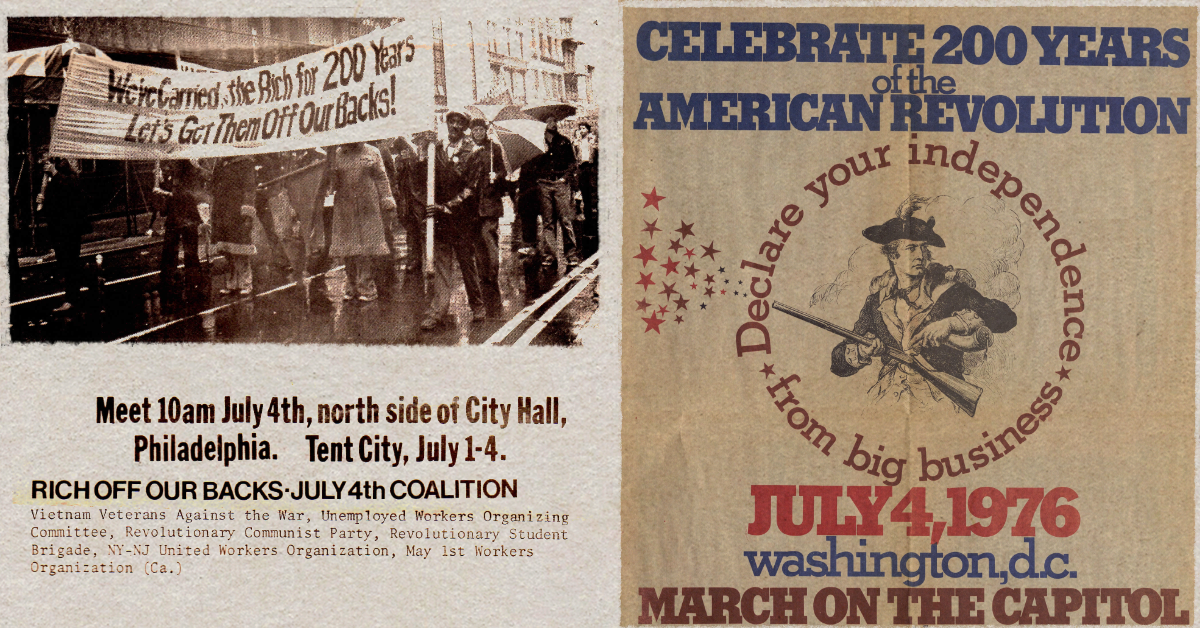
Although the PBC’s plans ultimately fell through, they weren’t the sole opposition to the Bicentennial. In fact, among the competing Philadelphia-based Bicentennial events were those hosted by another rising left-wing movement. First established by the Puerto Rican Socialist Party and American Indian Movement, Philadelphia’s tandem July 4/Rich Off Our Backs Coalitions comprised over 150 progressive groups, including but certainly not limited to: the Black Panther Party, National Organization for Women, Committee for an End to Sterilization Abuse, Gay Activists Alliance, Vietnam Veterans Against the War, Youth Against War & Fascism, Palestine solidarity groups, the Workers World Party, and the Revolutionary Communist Party (1, 15, 16, 17, 18, 19). Critically, the Philadelphia coalitions also represented the ideological “New Left” from which the PBC had been distancing itself — the former operated on intersectional frameworks and anti-imperialist positions, while the latter centered on economic democracy and the domestic laboring class. Given this, the Senate report’s fearmongering of far-left Marxist radicals who praised international communist leaders was not entirely unevidenced — but perhaps had the wrong target.
The Philadelphia coalitions planned multiple demonstrations leading up to July 4th but struggled to host them all amidst pushback from local authorities. Officials denied permits for events, forbade the construction of a planned Tent City highlighting Philadelphia’s unemployment and homelessness crises, blocked a Workers History Pavilion from joining the corporate booths celebrating (and profiting from) the holiday, and used police to blockade activists, in a series of intimidation and protest-breaking tactics hauntingly familiar to activists today (19). Despite these efforts, on July 4th, 1976, the Philadelphia coalitions successfully led a 40,000-person march through North Philadelphia’s working-class and minority neighborhoods, with signs and chants calling for “freedom for all oppressed nations,” “jobs and a decent standard of living,” and “full democracy and equality” (15). The march also featured speeches from prominent community leaders, including the Puerto Rican Socialist Party’s Secretary General Juan Mari Bras, Elaine Brown of the Black Panthers, prominent peace activist David Dellinger of the Chicago Seven, and President of the National Organization of Women Karen De Crow (18).
It was here, in these individual neighborhoods in just one city in the US, that grassroots opposition to official Bicentennial events — and thus official narratives of the nation’s history and place in the world — climaxed. Official plans celebrated 200 years of the nation (and major corporations branded their products accordingly to maximize attention), while local movements highlighted communities whose stories American history and policies overlooked and concealed. It was here that local coalitions brought America’s attention to the padlocked gates of its freedoms, as racial and gender minorities, immigrants, working and laboring classes, and colonized territories remained left out of the folds of once-promised democracy.
If 200 years of a nation’s founding document was still insufficient time to make good on its most basic promises, was this truly a day of celebration or instead one of shame?
It is worth highlighting the stark differences between the PBC’s ideology of the “Red, White, and Blue Left” and the Philadelphia coalitions’ placement in the ideology of the “New Left” in goals, rhetoric, and success. Although both considered themselves some level of progressive, they represented two very different strategies toward interpreting that label.
The New Left refers to the post-1960s, ideologically broad left-wing movement that prioritized domestic matters of social reform and liberation over economic matters, with an emphasis on solidarity with racial minorities and international communities. Rifkin and the PBC alleged the New Left’s internationalist focus came at the cost of solidarity with white working-class Americans, which they attributed to white guilt. Accordingly, they aimed to construct an American Left that maintained a progressive orientation centering primarily around this domestic demographic and achieving stateside economic reforms (7).
These differing focuses also shaped the ideologies’ different rhetorical strategies. The New Left deployed more overtly socialist and internationalist language, which arguably shaped the vocabulary and stylistic decisions today’s Left uses in our own intellectual discourse. The PBC’s American Left, on the other hand, consistently anchored its work in the language of the American Revolution and ideals of nationalism. They drew parallels between 1776’s British tyranny against the American colonies and 1976’s corporate abuses against American workers, using symbols of the Revolution, such as the “Don’t Tread on Me” snake and “Join or Die” graphic, in their official communications. They also praised many of the Founding Fathers for their radical nature, but quite selectively, as they overlooked the broad majority’s passive or outright support for enslavement, horrendous treatment of Indigenous peoples, withholding of civil equality and enfranchisement from women and freedmen, and establishment of the electoral college system — a direct result of their belief that the already-limited voting population was too uneducated to make political decisions. With this idealized portrayal of the American Revolution and its architects, the PBC operated on the understanding that the first Revolution was not yet complete, especially economically. They wanted to finish the job with their push for tax equity, wealth redistribution, and workplace and economic democracy (5, 7).
On one hand, the PBC’s intentional appeal to the spirit of American freedom and democracy, and thus the very foundations of nationalism, was brilliant: it resonated with their target audience of predominantly young, white, working- and lower-middle-class Americans, identifying their disdain for the system and using it to agitate further and develop a movement. They supported such efforts with a multidimensional outreach program spanning organizational publications, book deals with major publishing houses like Simon and Schuster and McGraw Hill, a national radio and TV program airing on over a thousand local channels, and partnerships with tens of thousands of student groups and churches (5, 13). On the other, the PBC intentionally pursued this avenue at the sacrifice of intersectional solidarity, particularly with intense criticism of the decade’s student and anti-war movements, adding themselves to an extensive list of past progressive movements that similarly engaged in exclusionary self-preservation.
Furthermore, the PBC’s growing popularity and ability to capture the hearts of a voter base that would otherwise remain largely in the political center failed to recover their image from Campaign Corporate Exposure and the Senate report’s (barely accurate) condemnations of its “communist” affiliations. The PBC’s constant distancing from factions who more readily accepted that communist label, as well as its self-identification with American democracy above all else, was insufficient in protecting them from the Red Scare and some of its perpetrators — in the public’s mind, they and the New Left had become the same, especially after government officials’ extensive fearmongering.
While all these factors came together to bring the PBC to a mediocre end with its underwhelming July 4th rally in Washington, DC, the New Left-aligned Philadelphia coalitions successfully brought in tens of thousands of progressives from across the country. Furthermore, many of the populist techniques the PBC utilized later came to be critical tools of the populist right, particularly the Tea Party with its anti-tax, anti-establishment rhetoric (7).
The PBC was by no means radical or “revolutionary” as they claimed to be, especially given their self-perceived need to limit their own intersectionality. In an era ripe with government dissatisfaction, the PBC encouraged Americans to take on a more scrutinizing perspective toward their elected leaders but failed to utilize the public’s sentiments to their greatest potential. In fact, the PBC's decision to center and preserve Americanism in their platform presented an ironic twist, as they inevitably co-opted the time period’s fanatic nationalist sentiment for their own gain, just like the political and corporate bodies they had been attacking for doing the very same.
Although far more ideologically left and under greater government and public scrutiny, the New Left presented another avenue through which members expressed and acted on their criticisms of the government, and was effective at building strong, meaningful ties within its communities. While the PBC rally fizzled out, organizations within the New Left’s ideological camp held a 40,000-person demonstration in protest of the official Bicentennial.
Fifty years on, the demonization of progressive ideologies and movements continues to guide institutional practice. The same mainstream Democratic Party’s ideology continues to fail in revitalizing our deteriorating living conditions and the nation’s morality. Maintaining centrist (“moderate”) leadership within the party has succeeded in undoing the vital work of the Voting Rights Act, Roe v. Wade, and Diversity, Equity, and Inclusion and affirmative action programs; eroding protections for gender minorities; enabling the rise of ICE as a paramilitary force at home; and financially propagating and rhetorically justifying genocide abroad.
Fifty years on, the ideological spirit of the New Left shapes the broader progressive movement(s) today, especially as we continuously expand our understandings of solidarity. Even then, as PBC leadership highlighted, the New Left fell short in connecting with the (white) American working class at times. The PBC thrived in that deficit but did so by portraying themselves as the patriotic left-wing group, unlike the New Left, who they saw as having given up on the promise of America and its democracy and radical historical figures (7).
Ultimately, the schism between the New Left and the PBC’s Red, White, and Blue Left was just one Nixon-induced iteration of a much longer-standing internationalism/labor dichotomy in American progressive thought. There remains a fragile, dynamic balance between solidarity with the domestic working class and solidarity with other marginalized identities, both at home and abroad. Indeed, just as both schools of thought struggled to strike their ideal balance then, we continue to reckon with the echoes of their ideological clashes today. Critically, however, the two are not mutually exclusive. To protect American workers necessarily means to protect all workers in America, including those with marginalized racial, sexual, and immigrant identities. To advocate for a more materially empowered and secure American working class necessarily means to de-imperialize and allow for the rise of an autonomous and materially secure international working class. To put more money in our pockets at home necessarily means to remove that money from Empire as it surveils, subjugates, and slaughters abroad.
Successes in labor and internationalism are interdependent, and both individually are dependent on constant, conscious engagement on our ends as organizers, intellectuals, and socialists. At the community level, this looks like sustained self-education, international education, and individual and collective reckoning with the dynamic balance between uplifting the vulnerable within our borders and uplifting the vulnerable beyond them. At the policy level, this looks like developing and supporting efforts that will simultaneously satisfy both of these goals.
Fifty years on, the same institutions some of our ideological predecessors fought against continue to dismantle the very framework of our communities in a domestic recreation of the decades of horrors they have unleashed abroad. Now more than ever, we maintain the responsibility to keep educating, to keep righting their wrongs, and to keep fighting for a better 50 years ahead.
1*: Stein, Marc. (2024, October 04). Queering the U.S. Bicentennial: Patriots, Protesters, Pornographers, and Profiteers. [Lecture delivered at William & Mary.] For more, see Stein’s Bicentennial: A Revolutionary History of the 1970s (2026).

