
Sam is a member of the Metro DC Democratic Socialists of America.
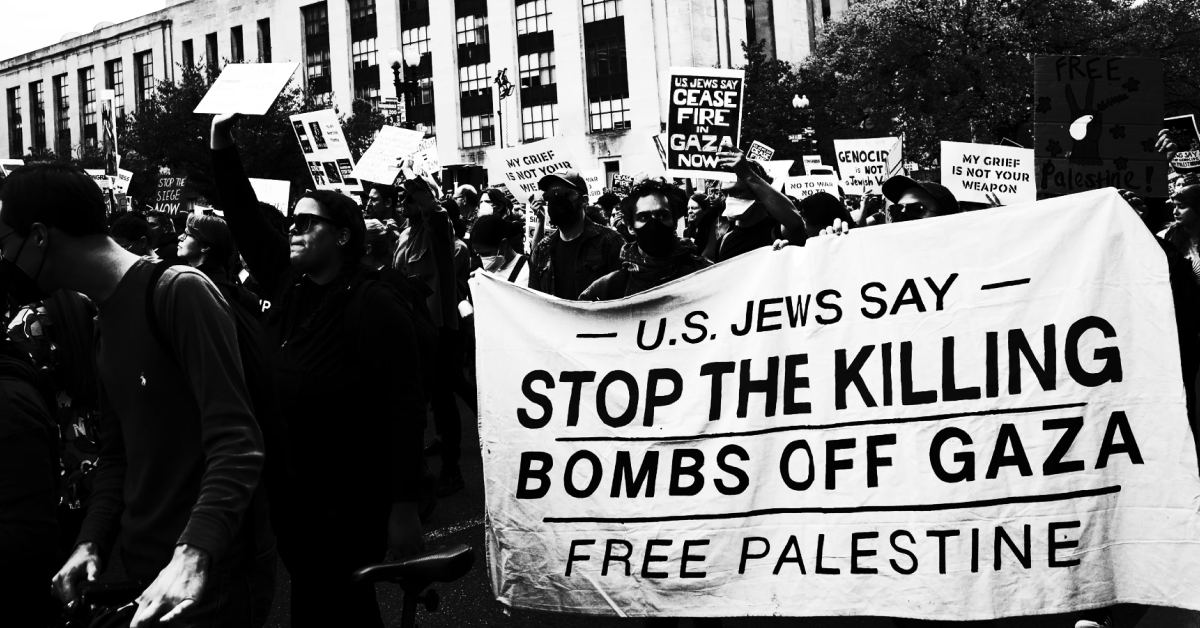
ISRAEL HAS BEEN BOMBARDING LEBANON, seeking its territory for annexation, and is threatening an eggshell-fragile ceasefire with Iran. For Israel, ensuring US support for its wars is an imperative. For socialists, opposing war, genocide, and apartheid is equally imperative. The Democratic Socialists of America have made their commitment to anti-Zionism clear, with both national and Metro DC chapter resolutions, and now Zionists have taken notice. Both DSA resolutions affirm support for Boycott, Divestment, and Sanctions against Israel, anti-imperialist coalition building, and electoral standards for endorsed candidates. Neither resolution refers to Jewish communities broadly — they focus on ensuring candidates publicly support Palestine and do not support institutions whose purpose is shoring up the Israeli state. And yet, like clockwork, the politically motivated accusations of antisemitism have started to roll in.
The DSA is familiar with these attacks. In Zohran Mamdani’s run for New York City mayor last year, Zionists were constantly pressuring him to water down his politics, to ignore Jewish socialist and anti-Zionist traditions in New York. Now, DC socialists are witnessing a similar media attack campaign against multiple endorsed socialist candidates. While anti-Zionism is not antisemitism, we live in a culture that often assumes they are one and the same. This is not an accident. What to do?
I want to consider some features of the capitalist society we live within (humor me). The United States is a settler colony state — and so is Israel. When we consider political discourse in the US about Israel, we cannot forget either fact. At bedrock, settler colonies are projects of exploitation focused on labor (rather than extraction of commodities per se). They use supplies of coerced labor and stolen land to build up profitable states, in contrast to extractive colonies that produce commodities to enrich an external state. In both cases, however, the maintenance of colonial relations is as much the work of ideology and culture as it is of overt political power. Cultural and ideological hegemony is the only way that smaller settler classes can hope to impose their control for long enough to complete their genocide of the native population of a land. Colonialism and capitalism are both social structures riven by extreme irrationality — they need to naturalize absurd inequalities and shocking acts of violence to such an extent that they seem inevitable, to both oppressors and their victims.
Palestinian academic Edward Saïd analyzed European colonial administration and uncovered how the entire field of “Orientalism” shored up colonial extraction. As a discipline, it gave Orientalists like Arthur Balfour mental frameworks to view and categorize the subjects of their exploitation. This intellectual ideology created solidarities across imperial powers that then drew those powers into war to protect their allies’ colonial interests. Saïd explains, “During the First World War, what was to become a major United States policy interest in Zionism and the colonization of Palestine played an estimable role in getting the United States into the war.”
The ruling ideas in the United States are no different. Colonial printing of novels and pamphlets solidified a new national identity but also settler opposition to Indigenous peoples. Captivity narratives like the 1682 A Narrative of the Captivity and Restoration of Mrs. Mary Rowlandson — stories about Euro-American settlers being kidnapped — were used to justify settler genocide during the Great Swamp Massacre of King Philip’s War. In Not “a Nation of Immigrants,” historian Roxane Dunbar-Ortiz examines how drek like JD Vance’s Hillbilly Elegy works on settlers’ guilty consciences. Vance mythologizes Scots-Irish settlers and plays into ideas of an aggrieved, white working class deserving of our universal sympathies. Apologia like Vance’s helps settlers complete “moves to innocence” so they can imagine themselves as blameless holders of a land they could never have an authentic relationship to.
Colonialism produces lies as easily as we produce breath. But the stains of its guilt persist, no matter how hard settlers try to wash them away. The product is a perpetual atmosphere of contradictory ideas, concepts, and culture that is simply bonkers. It would be easy to dismiss the fever dreams of capitalists and settlers as lies on their own merits, but examining them can also help us resist their attacks and organize ourselves. For, as Saïd reminds us, “fictions have their own logic and their own dialectic of growth or decline.”
Before we look at the current Zionist media campaign in DC, we should consider some of the requirements of Zionism as an ideology. For, despite the ancient provenance it claims for itself, Zionism was made by European Jewish leaders and intellectuals in the 19th century. Zionism was their intellectual answer to growing European nationalism (and antisemitism) and the threat it posed to the Ashkenazi diaspora and Jewish people more broadly. New European national identities and their antisemitic bases created a perpetual “Jewish Question,” because Jews and Jewish culture did not fit neatly into these schismatic nationalities. Zionism was just one of the solutions that European racists threw their support behind. Today, like other settler-colonial ideologies, Zionism needs a vast shroud to hide the violence it demands for the fulfillment of its desires and to salve the conscience of its followers. It also needs a clear, national Jewish identity to mark the boundaries of its territory, in land and in people.
To meet these needs, Israel and Zionist media have developed detailed strategies for covering over, hiding, or explaining away (hasbara) Israeli genocide and apartheid. “Liberal” Zionism provides coverage for the same by strategically presenting progressive views on every other political topic, except for Palestine. Zionists’ conservative roots are revealed by looking at issues of expression and thought. The strategic silencing of anti-Zionist academics, journalists, and teachers is one example. For another, Zionists undercut and erase secular or anti-Zionist Jews (like this author). As cartoonist Eli Valley lampoons in his satirical superhero comic “Israel Man and Diaspora Boy,” Zionists construct the Jewish diaspora as an embarrassing, pathological aberration — one that must be replaced.
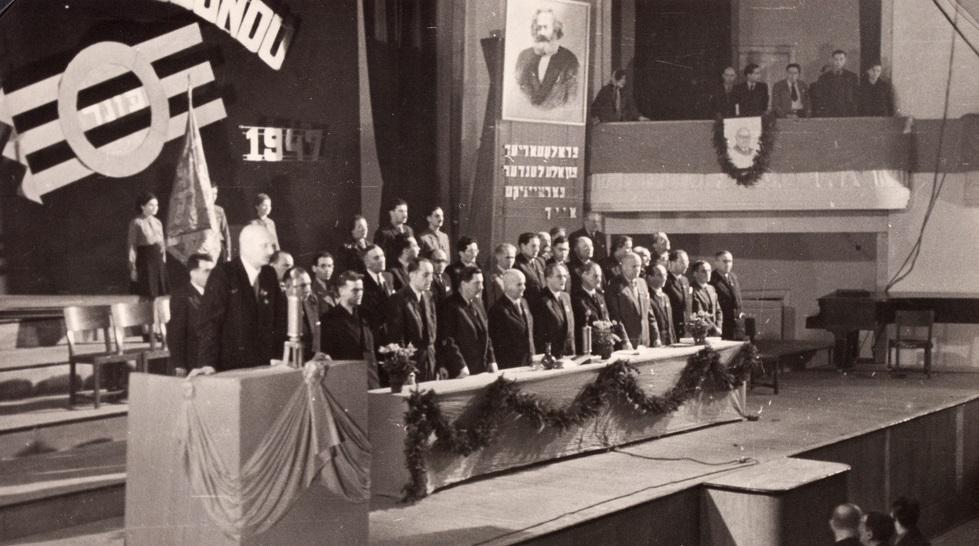
One of the first modern sites of this struggle over Jewish identity occurs in the history of socialism. In their oral history Revolutionary Yiddishland: A History of Jewish Radicalism, Alain Brossat and Sylvia Klingberg demonstrate the inexorable pull that Zionism had for Jewish leftists, including the Jewish Labor Bund: all of their interviewees, even the anti-Zionists, found reasons to migrate to Israel. Zionists, however, quashed their radical potential. Formed in 1897 by Jews in the Russian Empire, the Bund had promised a radical Jewish identity that would cross national borders, at a time when the working class was finding itself increasingly confined and organized within those borders. Within the communist movement, Bundists emphasized cross-national cultural organization, exemplified by their slogan “Where We Live Is Our Country.” Bundist immigrants formed the radical backbone of the US labor movement in the textile and needle trades. But Bundism was also a natural threat to Zionism, as Brossat and Klingberg explain:
“It was against the traditions of this revolutionary movement, against its utopia, its history and its memory, that the Hebrew state was established, along with its own founding myths [...] It is only too understandable that institutional Zionism has stubbornly stifled the memory of this movement; that the schoolbooks of Israeli children are silent about the Bund and the commitment of Jewish fighters on the side of the Spanish republic; that in Israel, Yiddishland is buried in museums, and the Yiddish language in libraries.”
These are things to consider when we look at Zionist propaganda — it violently narrows the core of Jewish identity into a relation to a settler nation-state. That is: most of Jewish history and culture is useless to it, including the American Jewish diaspora.
Let us now use a current example to see how Zionist propaganda works across institutions.
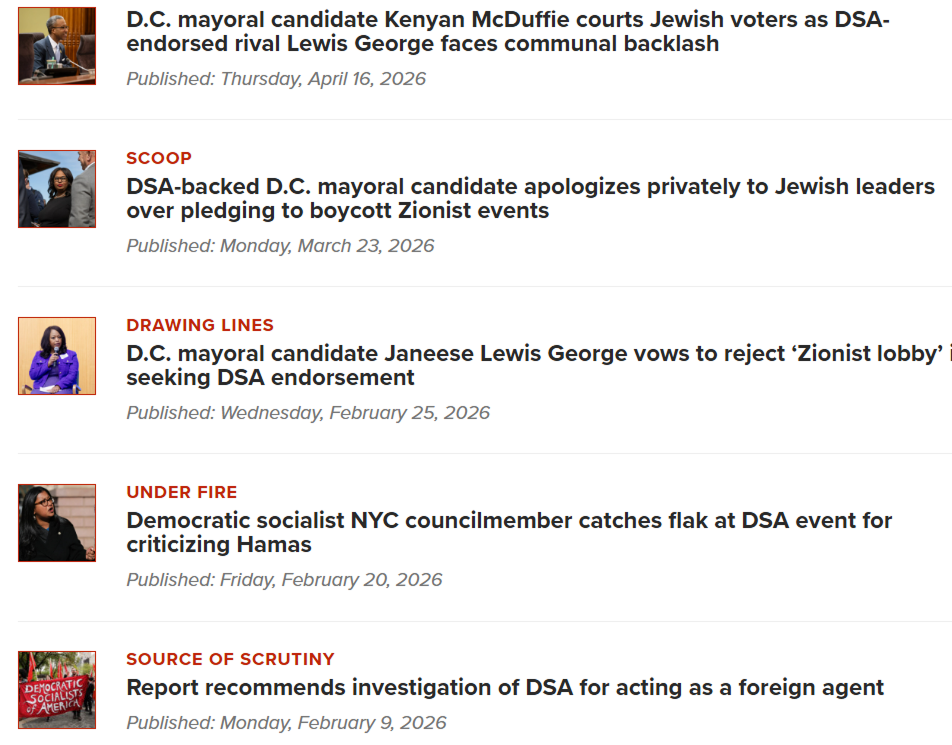
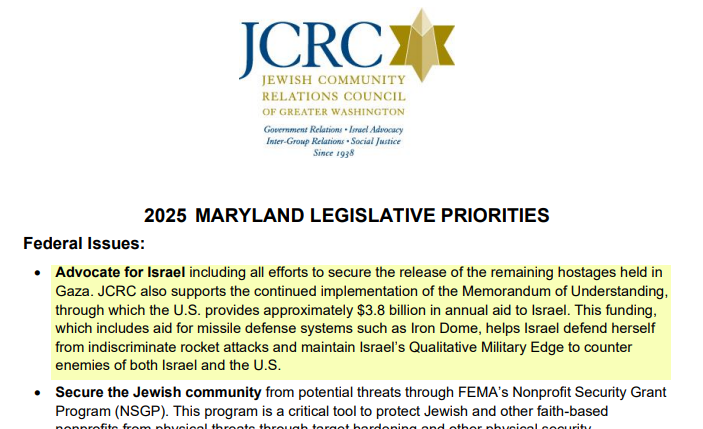
There has been no love lost between the Jewish Community Relations Council of Greater Washington (JCRC) and Metro DC DSA. The JCRC is a liberal Zionist project that conflates its pro-Israel advocacy with progressive causes. In its 2025 Maryland legislative priorities, the JCRC marked its first cause as “Advocate for Israel.” Progressive causes like gun violence prevention and reproductive healthcare make the list but are buried beneath the higher priorities of advocacy for Israel and the US security state. Through its ongoing spat with Maryland Senator Chris Van Hollen, the JCRC reveals its public role — to attack and demean progressive politicians until they are corralled back into silence on US bipartisan support for the genocide of Palestinians and war abroad. Stymied by Van Hollen, however, JCRC needs an easier target. In this election cycle, Metro DC DSA is their target due to our support of Palestine. Because they are a 501(c)3 nonprofit, JCRC is not allowed to engage in elections directly. Never fear, they found a way.
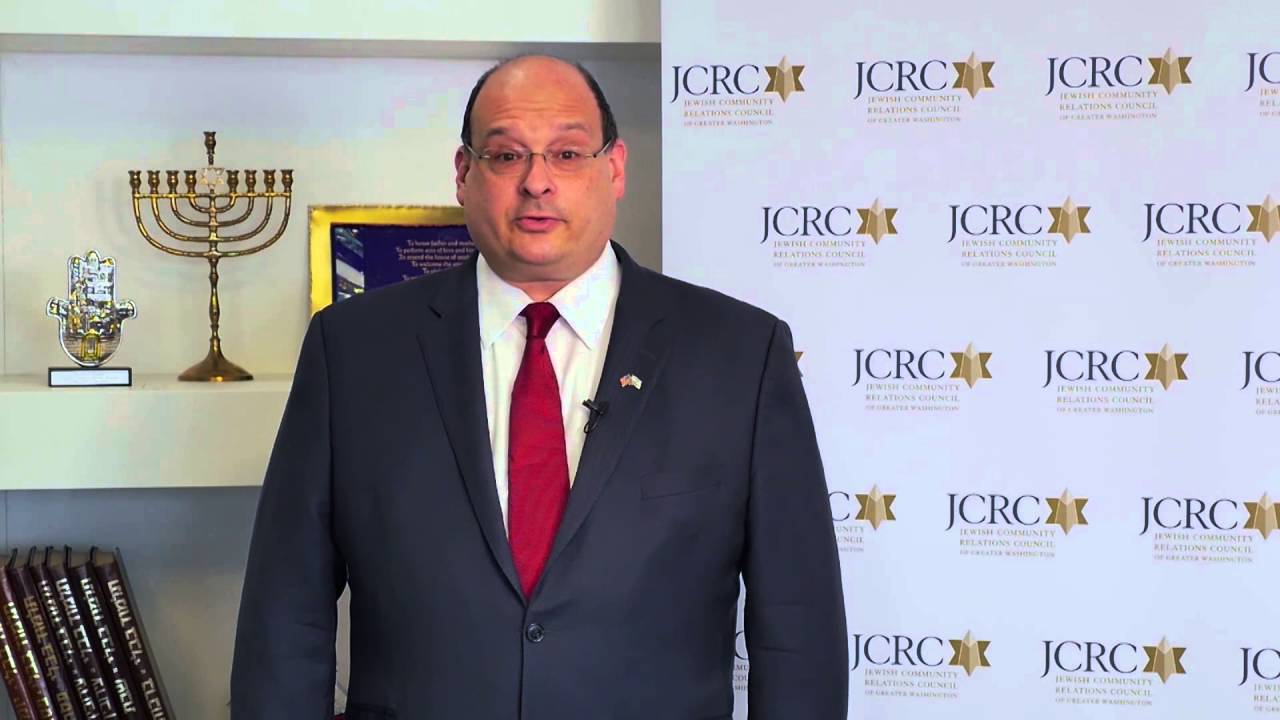
On February 25, JCRC CEO Ron Halber released a statement condemning Metro DC DSA and its electoral standards. To circumvent the 501(c)3 problem, Halber “urges candidates to not participate” in the chapter’s endorsement questionnaire. Using dual-loyalty language, Halber called our chapter “dangerously un-American.” He then, strategically, misrepresented the chapter’s commitment to anti-Zionism by claiming that DSA’s resolutions force the exclusion of Jewish people from public life. If Halber had bothered to read either Metro DC DSA’s or national DSA’s anti-Zionist resolutions, he would have seen that they do not. But honesty and fidelity to a text is not what Halber was going for.
The same day, Jewish Insider’s senior national correspondent Gabby Deutch wrote an article recycled from Halber’s press release. Deutch connected Halber’s smear with the MDC DSA-endorsed mayoral campaign of DC Ward 4 Councilmember Janeese Lewis George. To do so, she quoted extensively from Lewis George’s candidate questionnaire, but the only source in the article is Ron Halber himself. Deutch closed the article by providing cover for him and the JCRC: “Halber declined to comment on DSA’s endorsement of Lewis George, saying JCRC does not get involved in electoral matters as a nonprofit organization.” The next day, Washington Jewish Weekly also published an article based on Halber’s press release.
A month passed in quiet. The Lewis George campaign, presumably in an attempt to dispel Halber’s claims, held a meeting with several Jewish community leaders and rabbis on March 19. Rather than satisfying the JCRC and Jewish Insider, this was grist for the mill. On March 23, Deutch wrote about the meeting using two nameless sources “familiar with the meeting” and made sure to list the organizations in attendance: “Milton Gottesman Jewish Day School, the Edlavitch DC Jewish Community Center, Temple Sinai, Ohev Sholom, Adas Israel Congregation, Tifereth Israel Congregation, the JCRC, and Tzedek DC” [emphasis mine]. These unidentified sources and the names of the organizations are used to establish Deutch’s knowledge of the meeting, even though she herself was not in attendance. Deutch then filled her story with a pablum of vague but concerned statements, like “someone in the meeting described feeling hurt by [Lewis George’s] answers in the [DSA endorsement] questionnaire.” Who was this person? What was their exact concern, and why did they have it? Deutch remains consistently oblique on these basics. The use of Ron Halber as the only named source in Deutch’s writing means that no other Jewish community members, Lewis George supporters, or DSA representatives are allowed a voice in the story. Instead of Deutch waiting a single day to get additional comment, only the JCRC is on the record. The final story looks like journalistic inquiry, with none of its substance.
The same day, and cited in Deutch’s reporting, Halber published a melodramatic op-ed claiming that Metro DC DSA is trying to displace Jewish people from the DC metro region with its “anti-Jewish loyalty oath.” Deutch made sure to remind readers in her article that “[Halber] did not specifically mention Lewis George.” The next day, Lewis George’s largest-looming mayoral opponent, hapless Kenyan McDuffie, sensed an opportunity. He used the story to decry the idea of political opposition to Zionism, or any cause really, in a campaign email. Jewish Insider thanked him for the assist, and Deutch rushed an article out about his email that day to extend the story.
Let’s pause. What is even happening? Only the Washington Post and Washington Informer provided responsible coverage of this incident. (Funnily enough, in the Washington Post rundown, McDuffie walked back even his milquetoast complaint about DSA’s electoral standards: “Asked to explain his position on the Israel–Palestine conflict, McDuffie said he was focused on other issues and not foreign policy.”) The Post uncovered little to report of substance. Under actual journalistic questioning, Halber withers into having “a lot of concern,” and “Wolkenfeld, the rabbi from Shepherd Park, said he left the meeting feeling he and others were heard.” More recently, Deutch interviewed McDuffie for Jewish Insider. He used the platform to burnish his liberal Zionist credentials by continuing to waffle. (I do not envy the Zionists. It must be difficult to gas up a candidate already so full of hot air.)
If we look past the concern trolling, we see a political controversy (if we can even call it that) produced solely by the JCRC. Halber and JCRC attack Metro DC DSA in a press release. Jewish Insider launders that single press release into A Story about Lewis George. When the Lewis George campaign attempts to address the named criticism by meeting with Jewish community groups, that very action is used to extend and deepen the controversy, rather than resolve it. That is because the JCRC and the Jewish Insider sources in that meeting do not actually care about the criticism they raised. Presumably they agreed to the premise of the meeting they attended. They should be happy; they were heard. Instead, the response of the campaign is taken as a further opportunity to try to drive a wedge between Lewis George and her base.
We can now return to the idea I mentioned earlier, that settlers like Zionists need to produce confused ideas to help justify themselves. This time, let’s look at the logic of Halber and JCRC’s statements.
As Bennett Shoop writes in People’s World about another recent pro-JCRC article, “This kind of propagandistic hysteria — which frames a candidate endorsed by Jewish groups, like Jews United for Justice, as antisemitic — is an embarrassing and desperate attempt to conflate a refusal to support the Israeli state’s long history of human rights abuses, genocide, and ethnic cleansing as indicating a hatred of the Jewish people.” The logic of Halber is: being anti-Zionist and being antisemitic are equivalent; the socialists are anti-Zionists, so they are antisemitic. Unfortunately for all of us, the conductors of this media orchestra have forgotten the deep ties between Jewish radicals and the socialist movement. I am Jewish, and I am a member of DSA. So, by Halber’s rule, I am antisemitic. Zionism as a project necessitates the erasure of diverse Jewish identities, and the discourse on “self-hating” leftist Jews is the result. It is ugly.
We can also look at Halber’s rabid statements in another light. Halber does not care about all Jewish people because of his Zionist ideology. Instead, his attacks against the DSA are him picking up that lazy cudgel of American conservatives — redbaiting. This is an effective rhetorical tactic in the United States, buttressed by generations of fearmongering and repression. And it is a dangerous tool for Halber to rely on. Jewish people have paid for the US’s traditions of anti-socialism in blood, because we do not fit the narrow needs of US nationalism and white supremacy: we are subject to political loyalty tests in a way that white goyim are not. In 1953, Cold War paranoia led the federal government to try, convict, and execute Julius and Ethel Rosenberg out of fear that they had spied for the Soviet Union. Over the decades, the US Right has produced endless antisemitic dogwhistles about “cultural Marxism” to take advantage of these fears. In fact, the use of redbaiting reveals how shallow the JCRC’s progressive veneer is. They would rather attack the most progressive mayoral candidate than compromise on Zionism.
I want to end with a couple practical points. The incident above is technically new, but it is an extremely predictable dilemma for Left–liberal coalitions. As the Left, we have to be prepared for conservatives to use every tool available to them to obscure the cause for which we fight — our collective liberation.
As socialists, we must expect and prepare for more media hackwork like this. We should not blink when conservatives, like Zionists, search for ways to splinter us and produce incidents intended to pull candidates away from liberatory causes. If we believe that fighting for those causes makes our work hopelessly unappealing to elected officials, we have to find ways to organize, not despair. We need to assert our own narratives and our politics to the public, to friendly publications and neutral venues alike. Workers know that war and genocide are wrong. It is only in the moments of chaos produced by capitalist media that it seems otherwise. We also should be confident in the work that we have done — media is a critical tool in moments of mass indecision, but ultimately, organizing is what builds the collective will of the working classes. Finally, we must do better to bolster anti-Zionist Jewish identities. The DMV, for example, has its own chapter of the Jewish Labor Bund. We cannot allow Zionists to destroy the history of Jewish leftism.
For progressive campaigns, the time for equivocation on Palestine is over. Support for Israel or feigned neutrality is no longer part of a sensible political calculus — something Democratic leadership is still unaware of. A majority of Americans no longer support Israel, in light of the ongoing genocide in Gaza. As of last month, 67% of registered Democrats say their sympathies are with Palestine, versus 17% with Israel. As Israel continues to threaten any possibility for peace, its actions will not be a popular cause even among the moderate. But the media strategies used by Zionists do not allow your equivocation either. They attack their enemies and use any appeasement of their assumptions to generate more propaganda. So: refuse to equivocate. Instead, respect the energy and commitment of your base.
And, to any Jewish Zionists reading, do us a favor and calm your mishegas. Read about our history, which your cause tried to bury alive.


