

Shaheen Khurana is a member of Metro DC DSA and a public-interest technologist.
THERE IS SOMETHING REMARKABLE HAPPENING ACROSS AMERICA. Community resistance to data centers has sprung up in localities from Arizona to Virginia, from Texas to Wisconsin. Ordinary people are discovering a fight they can actually win, not against some abstract enemy or distant war, but the massive, resource-hungry, surveillance-enabling facilities that Big Tech billionaires are trying to erect right in their backyards.
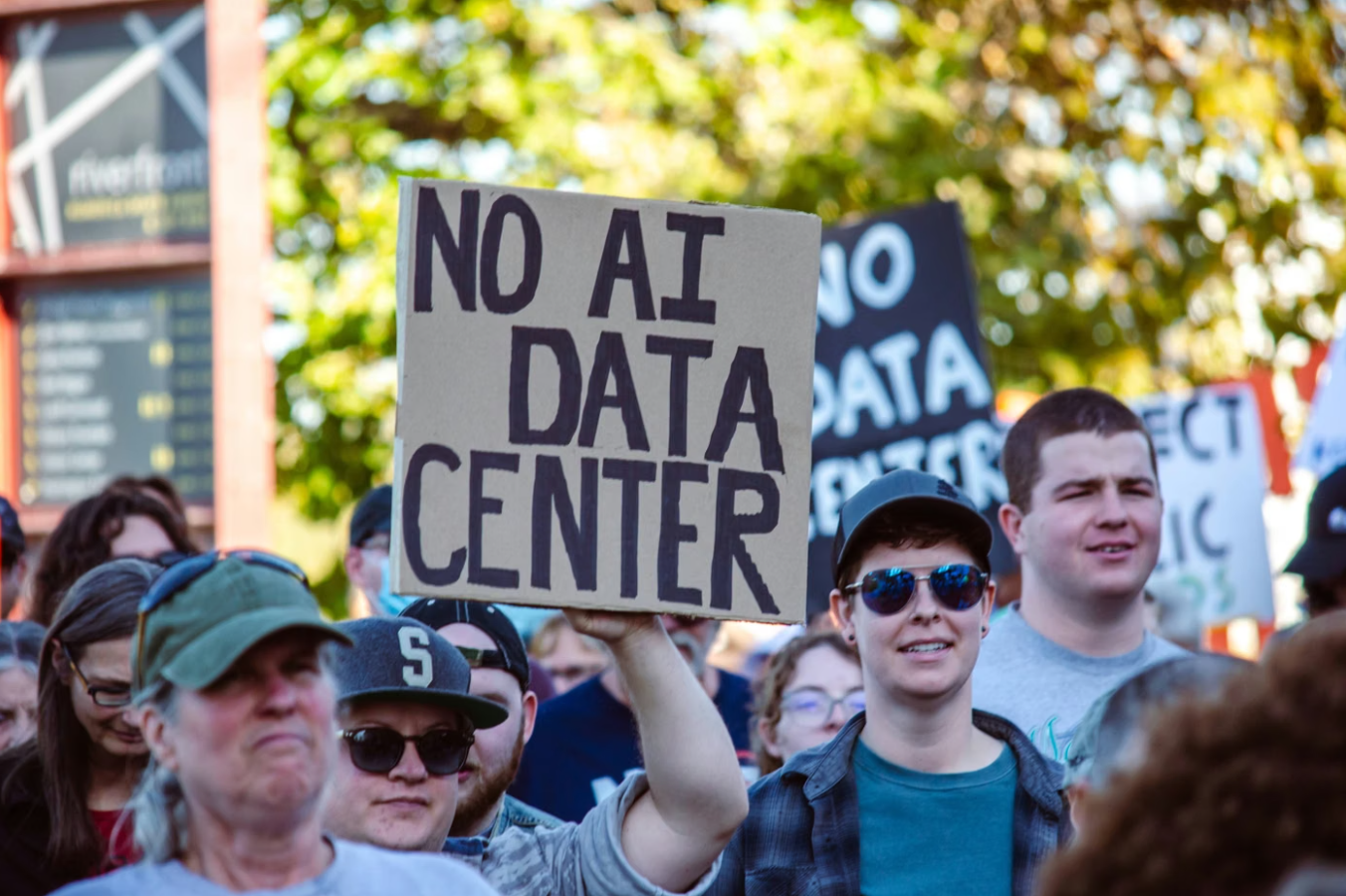
This resistance to data centers is organic, grassroots, and deeply local. It is homeowners associations, environmental groups, historical preservationists, farmers, teachers, and retirees. It is Democrats and Republicans. Data centers are a physical manifestation of Big Tech’s unchecked corporate power, serving as a concrete target of Americans’ apprehension toward the industry, and one they can see, smell, and organize against.
The fight against data centers and the corporations they represent is a fight for environmental justice. It is a fight for water rights. It is a fight for community self-determination. And it is a fight against the billionaire class that has captured our political and regulatory apparatus and is now using AI to entrench its power — both abroad and at home.
This is also not a fringe movement. A 2026 poll found that roughly 71% of Americans oppose having data centers built near them — up significantly from 42% a year earlier. Nearly half of all Americans (48%) strongly oppose them. And just 7% strongly favor data centers being built in their area. Data centers have also played a central role in the Democratic primaries this year: the popularity of progressive Democrats Will Lawrence, Abdul El-Sayed, and Justin Pearson was partially due to their clear policy goals opposing data center development, and they won their respective elections. These sentiments also played a central role in the recent 2026 mid-term elections and will do so for the 2028 general elections.
Opposing data center construction is one of the most popular political positions a candidate can hold right now. Accordingly, progressives and socialists have a rare opportunity: such populism across party lines already aligns with their principles, establishing the path to a concrete, winnable fight against billionaire class power by connecting local grievances to a national struggle for a just and sustainable future.
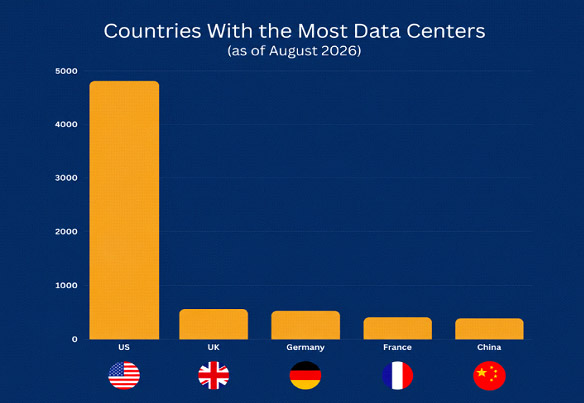
Data centers are no longer the relatively harmless server rooms of the past. Hyperscale AI data centers are industrial facilities the size of small towns. More data centers are planned for the United States than any other country on Earth — nine times more. The computing capacity could increase by approximately 1,000% if all planned projects go ahead.The planned buildout across the country would require terawatts of new electricity — much of it from gas plants — and billions of gallons of water per day.
Virginia's "Data Center Alley" in Northern Virginia is already the largest concentration of data centers in the world, and keeps growing despite mounting local opposition.
The harms of data centers are concrete, measurable, and multifold:
And make no mistake about who bears the heaviest burden of data centers’ ecological and military exploitations. They aren’t being built in wealthy, white, well-connected neighborhoods, but disproportionately in working-class communities; rural towns; and Black, Brown, and immigrant neighborhoods — the same communities that have long been sacrifice zones for other polluting industries. Data centers follow in the footsteps of their corporate predecessors: they extract natural resources and exploit labor for private profit, and dump the environmental and health costs on those with the least political power to resist.
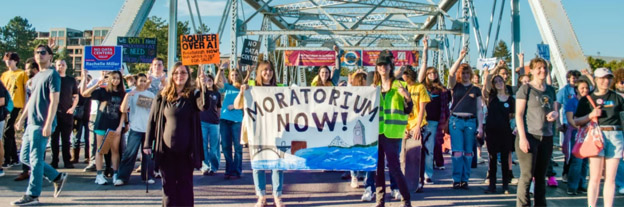
The anti-data center movement is gaining momentum and notching up victories. Bipartisan opposition has fueled populist mobilizations across the country and legislative pushes to regulate and roll back data center growth. This past summer, a nationwide day of action against data centers claimed 142 protests in 42 states.
Data Center Watch claims that the first quarter of 2026 saw a record grassroots victory of 75 data center project delays or cancellations worth $130 billion. Even in Texas, a data center juggernaut, far-right wing Republican Governor Greg Abbott has paused data center buildouts due to the immense strain they have imposed on the state’s already fragile electrical grid and the resulting mass opposition from communities.
More locally, Virginia has long been ground zero for this movement, and its communities’ victories against data center plans reveal the possibility of a more sustainable future. Prince William County’s 2022 “Digital Gateway” plan threatened a $100 billion transformation of Gainesville’s rural farmlands and historic sites into a massive data center campus. Residents fought back, forming a coalition of homeowner association groups, environmental protection groups, and historical preservationists to organize against the noise, power lines, falling property values, damaged history and agricultural spaces, and more that the data center would have imposed on the town. Then, activists found something more: public notices had been posted within less than the required six-day interval. The Virginia Court of Appeals invalidated the rezoning. Facing years of legal uncertainty, the developers — Compass Datacenters and QTS — withdrew in April and July 2026, respectively. A $100 billion project was stopped by a procedural error and a community that refused to back down.
What unites this movement is simple: people refuse to let unaccountable billionaires sacrifice their communities, their water, their air, their land, and their democratic agency for the sake of training ever-larger AI models to serve corporate profit at immense cost to the everyday working classes.
The most potent force in American politics today is anti-establishment fury at a system seen as rigged against average working people. AI, and all the infrastructure powering it, has become a primary symbol of that rigged system.
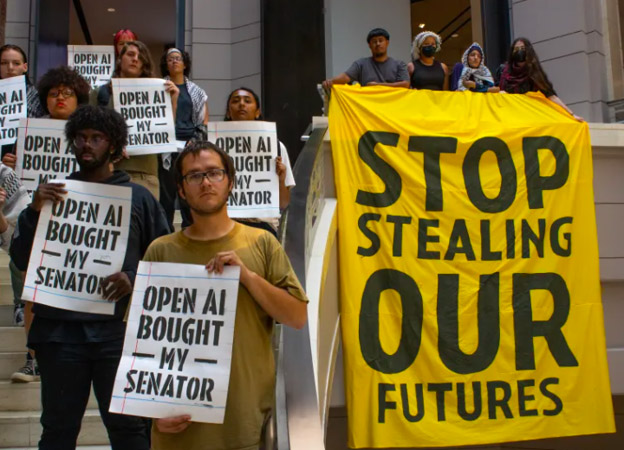
In August 2026, student activists came together to occupy the Gallup Building in Washington, DC, home to a public-facing lobbying office belonging to ChatGPT developer OpenAI. Once inside the building’s main lobby, demonstrators unfurled a large banner reading, “Stop Stealing Our Future,” while others held signs proclaiming “OpenAI bought my Senator.” Dump Big Tech, a coalition of grassroots groups spanning labor to media, organized a series of actions to pressure elected representatives into standing with their neighbors, not the corporations using AI and toxic data centers.
This anti-data center populism is reshaping American politics as well. Will Lawrence, the Sunrise Movement cofounder who is running for Congress in Michigan’s Seventh District, won his primary with a campaign aimed at “tech billionaires,” who he said want to turn Michigan’s farms into data centers that will “jack up our energy bills and ruin our home values.” Abdul El-Sayed, running for Senate in Michigan, used an under-construction OpenAI data center as the backdrop for a rally. “Until we protect local communities from the power of corrupting money and politics, we’re going to continue to see projects like this get pushed,” El-Sayed said.
Justin Pearson, a progressive candidate in Memphis, has similarly made the fight against xAI’s data center construction a centerpiece of his campaign. “Before data centers were all the news every single day, our community was fighting Elon Musk,” Pearson said at a recent press conference. Musk began building data centers in Memphis — and gas turbines to power them — in 2024. People like SpaceX’s billionaire owner, Pearson said, “view these communities as sacrifice zones.”
As these facilities sprout across the nation, the movement against them is rapidly developing the tools necessary to challenge the tech companies building them. The spread of data centers raises critical environmental, health, economic, and political questions — questions that health, climate, and social justice activists are uniquely positioned to elevate.
Reality check: Big Tech still has enormous financial and political muscle.
To fight the all-gas, no-brakes approach to data center and AI development, we need a powerful toolkit. What we do have working for us, though, is the fact that Americans overwhelmingly hate data centers.
Here’s how we can take advantage of that hate to achieve material victories:
Across the country, people have stood up to them, and that’s given us the possibility for real change. Let’s take it.
The sheer amount of money and power Big Tech corporations are willing to spend can be demoralizing. AI super PACs are spending millions of dollars funding political campaigns for politicians who are little more than their puppets, all for greater legislative lenience and favorability.
Activists standing against the attempted takeover by data centers and AI companies raise core questions: How do we govern this technology to shift power back to the people? How do we rein in AI oligarchs and break up the tech monopolies undermining our democracy and poisoning our communities? Who should decide whether communities allow data centers? How do we elect policymakers who answer to people, not corporate profits?
Using the experiences of past activist campaigns, the growing anti-data center and AI movement can put these questions on the nation’s electoral and political agenda. A growing number of grassroots and nonprofit organizations are tracking Big Tech and AI's anti-democratic grip on U.S. politics — mapping revolving-door appointments, AI super PAC spending, and dark money networks. They are exposing the human, ethical, and environmental devastation of hyperscale data centers and mass surveillance, and using social media to arm communities with investigative data and direct-action tools to push back. In doing so, they have become a powerful force to fight back. Technology must serve humanity, not exploit it.
In the words of Willie Nelson, "The last thing we need is a loud, water thieving, light polluting, data center anywhere near our town."

