

We Power DC is a coalition of community members and organizations fighting for a publicly owned electric utility system in the District. The campaign is led by members of the Metro DC Democratic Socialists of America (MDC DSA) chapter and is guided by ecosocialist principles.
IF YOU PAY FOR ELECTRICITY IN DC, it should come as no surprise to learn that Washington’s power bills are rising faster than anywhere else in the country. Residents have watched their electric bills increase by 93% in just five years; in July, they increased yet again, and in November, they are set to increase even more. With groceries, rent, and the overall cost of living getting more expensive, DC residents have their backs against the wall — and elected officials are taking note. That is why ecosocialists must take this opportunity to present a new way forward and channel rising dissatisfaction into widespread support for a democratically governed and publicly owned power utility for the people of DC.
In DC, electricity is currently distributed by the Potomac Electric Power Company (Pepco), a subsidiary of the multi-state, for-profit corporate giant Exelon. Meanwhile, natural gas is currently distributed by Washington Gas, another for-profit, shareholder-owned utility. These utilities are regulated by the Public Service Commission (PSC), a three-person board appointed by the DC mayor and approved by the DC Council.
Everyone needs access to affordable electricity, but that goal is fundamentally unachievable when large corporations use our bills to maximize their profits. We Power DC, the local campaign for a publicly owned utility, envisions a system with lower rates, community control, and investments in clean, reliable energy. We Power DC asks DC residents, candidates for public office, and elected officials to sign on to their Public Power Pledge, which outlines the vision for a publicly owned energy system that puts people before profit. The Pledge is centered around four principles:
During the 2026 primary season, five candidates running for DC public office signed the Public Power Pledge. This speaks to the widespread support for utility reform. The 2026 signers are:
Of those five, Raj and Owolewa won their primary elections and will be on the ballot in November. With these public power champions in office, there is more potential to advance legislation to rein in the corporate greed of DC’s private utilities and build a public power future.
Ward 1 DC Council candidate Aparna Raj released a campaign platform called Clean, Affordable Energy, which includes reforms that would lower electric bills by regulating utility monopolies; invest in cheap, reliable, and renewable energy resources; create good jobs and protect DC’s consumers; and democratize DC’s utilities. According to her campaign website, Raj believes that “public ownership puts the city in charge of its energy future, provides greater accountability to residents, and allows the city to provide clean energy at affordable rates.” These values directly align with We Power DC’s Public Power Pledge.
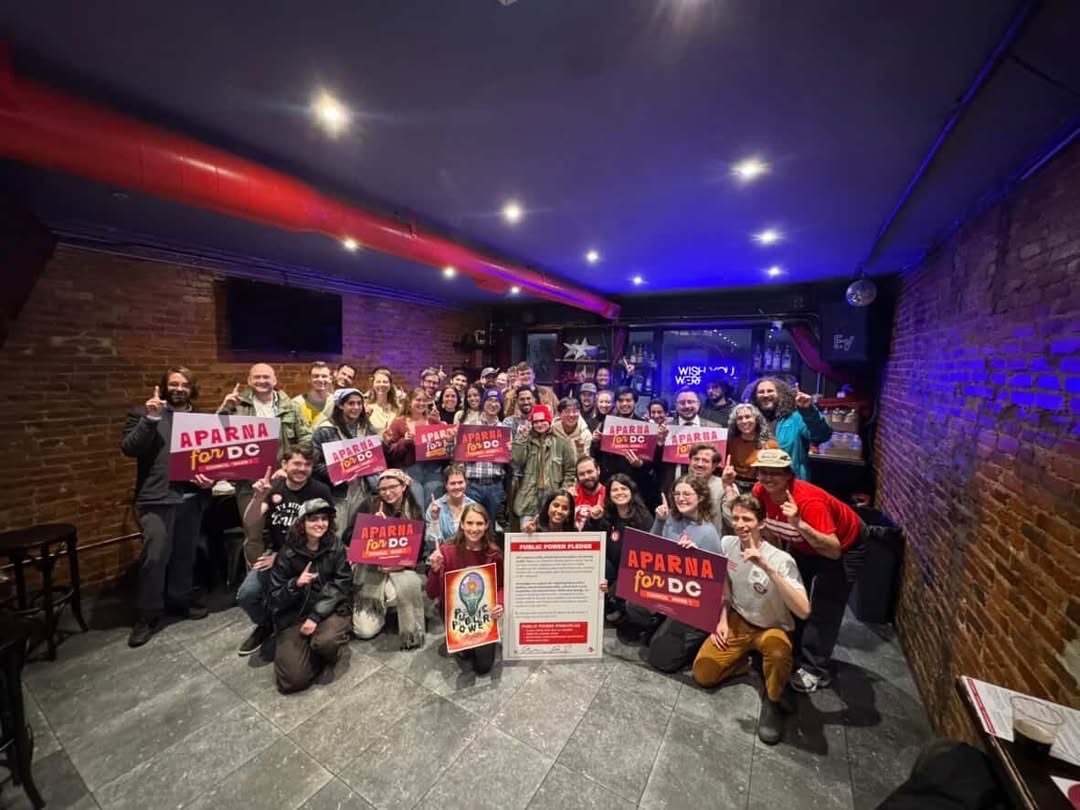
Representing DC as a shadow member of the United States House of Representatives since 2021, At-Large DC Council candidate Oye Owolewa has advocated for DC statehood and autonomy for years. A public utility is a critical component for independence, bringing power and the control of essential services back to the people of DC. Owolewa includes utility reform as a campaign issue and was the first 2026 candidate to sign We Power DC’s Public Power Pledge. As a healthcare professional, he understands that utility shutoffs are a public health issue: losing heat in the winter, or losing electricity for cooling during the summer, results in unsafe temperatures and spoiled food and medications. As a councilmember, Owolewa commits to “strengthen[ing] shutoff protections and expand[ing] utility debt relief so no household loses essential services during financial hardship.”
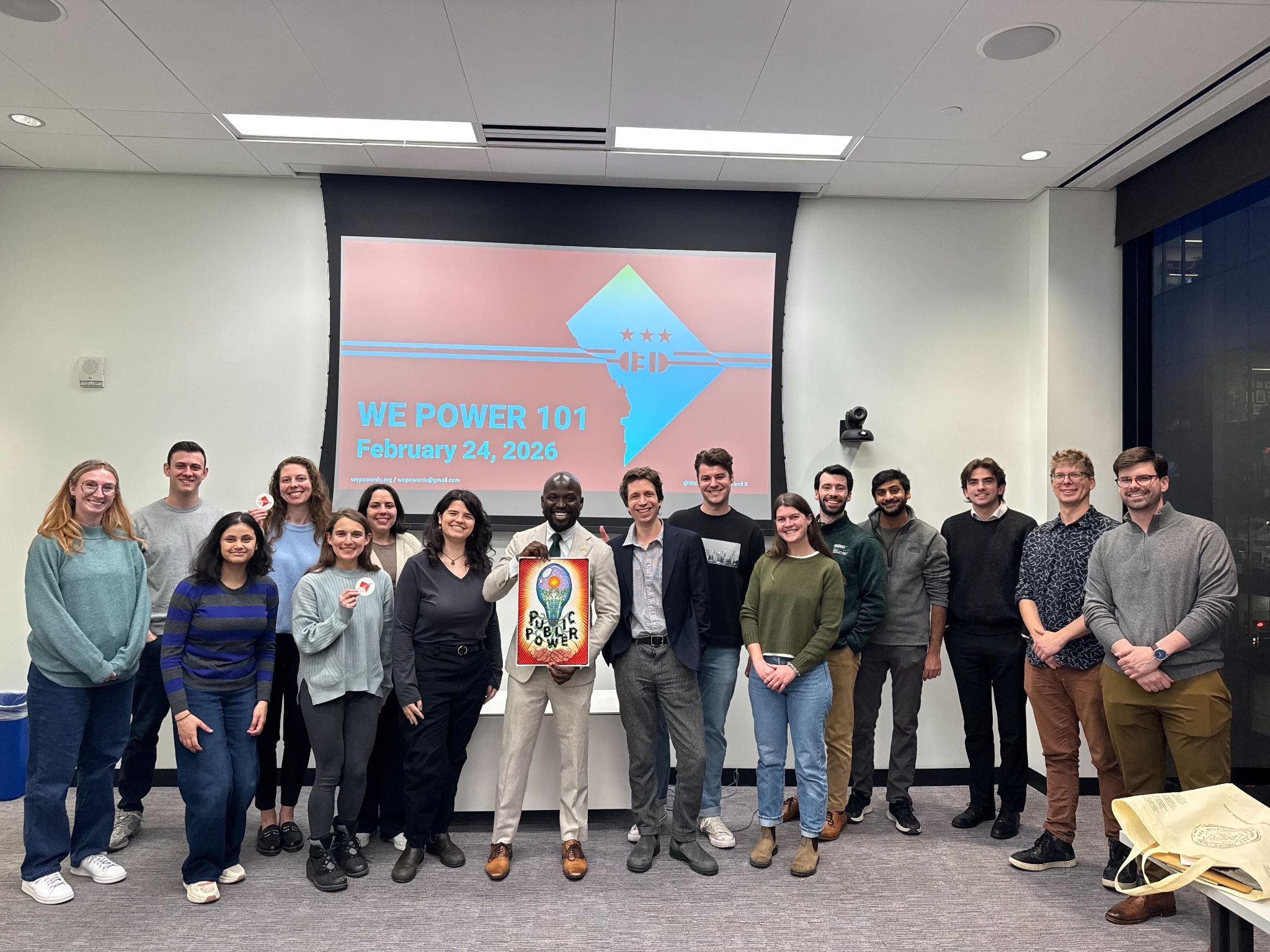
Having two Public Power Pledge-committed councilmembers join longtime utility reform advocate Charles Allen, who also won his primary re-election for the Ward 6 DC Councilmember race in June, will create a critical voting bloc that will work towards a public power future. We Power DC and coalition partners have been pressuring the current Council to reject the reappointment of two PSC Commissioners, Emile Thompson and Ted Trabue, who have spent years rubberstamping Pepco’s rate hikes. Organizing has been extensive and the public hearings have been intense. At the end of July, Thompson announced his resignation rather than continue to face pushback on his reappointment. As of early August, Trabue’s reappointment is still under consideration. We Power DC is advocating for these two PSC appointments to be made by the new incoming DC mayor, as PSC commissioners serve four-year terms. With a Council of elected officials who ran on platforms of utility reform, there is a higher likelihood they will reject the appointments of PSC commissioners who are in the pockets of the utility corporations they are supposed to be regulating.
While previous DC councilmembers have attempted to pass bills favorable to public power, they have not been successful — largely because of former At-Large DC Councilmember Kenyan McDuffie’s poor chairmanship of the Committee on Business and Economic Development. With two new public power champions and guaranteed new leadership for the committee that oversees utilities, a pathway is emerging for public power legislation.
One legislative option is introducing a District budget with funding allocated for an independent feasibility study to analyze the value of Pepco’s and/or Washington Gas’ local grid assets, the cost to buy them out and the long-term impact on ratepayers. In the mid-2010s, the DC Council attempted to launch a true municipalization feasibility study, but DC Mayor Muriel Bowser stepped in to limit its scope. This resulted in a watered-down report that does not mention Pepco once and reports little information specific to DC. Additionally, the Council can advance legislation to limit Pepco’s high return on equity (ROE), which determines how much Pepco can profit from its capital investments. It is well reported that utility ROEs across the country are far too high, as they account for 15-20% of the total cost of a customer’s bill. Finally, the Council can pass a bill to create a Distributed Energy Resource Authority (DERA), which would strip Pepco of its grid planning authority and give it to the District. An independent DERA would allow DC to make grid investments to increase renewable energy adoption, lower rates, and ensure effective and efficient operation of the grid. The DC Council proposed this in the past under the Distributed Energy Resources Authority Act of 2018, but it was defeated after Pepco heavily lobbied against it. Reintroducing or writing similar legislation would be the first big steps DC takes in moving towards public power under a new, more progressive DC Council.
While Raj and Owolewa will not make up a majority on the Council — and therefore cannot pass legislation taking ownership over DC's private utilities — they can use their roles to increase utility oversight. If they join the Committee on Business and Economic Development, which oversees utilities, they can utilize public oversight hearings to grill Pepco executives on the corrupt rate hikes that are putting DC residents in debt and interrogate their mismanagement of community solar programs, including inaccurate solar installation metering that has resulted in undercounting generation and slowrolling local rooftop solar projects. They can also introduce targeted, standalone bills as stepping-stone policies, making it easier for moderate councilmembers to strengthen and enforce utility regulations. Potential legislation could focus on increasing transparency and reducing the influence Pepco and Washington Gas have by limiting how much money they can spend on lobbying and corporate advertising within DC.
The conversation around utility reform has also made it into the DC mayoral race. During a mayoral forum on April 20, 2026, candidates were asked what actions they would take to make utilities more affordable for residents and businesses. Mayoral candidate and Democratic mayoral primary winner Janeese Lewis George, who passed emergency shutoff pause legislation during her time as Ward 4 Councilmember, talked about her energy platform: Affordable Utilities for All. Lewis George most recently co-introduced the Public Trust in Utility Regulation Act of 2026, which will require electric and gas companies seeking rate increases to provide detailed information about the purpose, cost, and anticipated benefit to consumers in addition to establishing audit requirements. As mayor, she said she would focus on appointing Public Service Commissioners who put people first and address the barriers low-income residents face in enrolling in energy assistance programs.
Lewis George has expressed an openness to exploring public power options for DC. However, she has yet to make an outward commitment to advancing public power legislation, and thus far has not signed the Public Power Pledge. This presents a continued need for organizing by We Power DC and coalition partners who believe that an equitable energy future built with socialist principles can only be done through a democratic, publicly owned utility.
With elected officials not just supporting but advocating for public power, they are prioritizing local democratic governance and accountability over corporate shareholder returns. Multiple public power champions in elected offices provides a number of distinct benefits for a public power future.
If DC transitions to a publicly owned utility, the utility’s governing body becomes the local government: the DC Council, the mayor, and the PSC. This shifts the utility’s mission from maximizing profit for far-away corporate shareholders to maximizing the public good for DC residents — elected officials answer to voters, not investors. With a publicly owned utility, elected officials have more influence over utility operations to ensure they align with the District’s municipal needs and residents’ wishes. A local government made up of elected officials who support public power will ensure this management is focused on benefiting the people of DC, not profit.
In DC, over 20% of all households are in utility debt to Pepco, with over 50% of all low-income households behind on their bills. For Washington Gas, 15% of customers are in utility debt. The current PSC, appointed by outgoing Mayor Muriel Bowser, has approved historic rate hikes which are being challenged in the DC Court of Appeals. Low-income residents experience a disproportionate energy burden, as they pay a higher percentage of income toward utilities.
This would change with a publicly owned utility. Public utilities have greater flexibility to create progressive rate structures and manage low-income protection and utility debt relief programs. Because some of these programs are already administered at the DC government level, aligning their management with the public utility’s management would streamline operations and ensure the most residents benefit from these programs. For example, the Utility Discount Program is currently managed by the Department of Energy and Environment (DOEE), but it could be moved under the public utility’s authority.
There are two main progressive rate structures which would make electricity rates more equitable. An income-based pricing method is similar to a progressive tax system, meaning the price consumers pay per kilowatt/hour of electricity would depend on their income. A usage-based pricing method would create increasing rate blocks to keep the cost low for essential needs, such as residential consumption, and increase the cost for heavy users, such as energy-intensive data centers. Both progressive rate structures would institutionalize affordability within the public utility.
DC has ambitious climate and electrification mandates, aiming for 100% renewable energy by 2032 and full carbon neutrality by 2045. These are mandates advocated for by DC residents and voted on by DC elected officials. Pepco has been slow to move toward meeting these goals, as integrating distributed energy resources — like local rooftop solar and community microgrids — competes with the utility-provided power service.
If the DC government were to control the utility, this conflict of interest is removed. The utility becomes an instrument of public policy, an avenue to implement climate action and invest in green energy infrastructure. If the DC Council mandates grid upgrades, the public utility could execute those investments without pushback or litigation often brought forth by private utilities. One of We Power DC’s current campaign priorities is for DC to invest in government-owned community energy infrastructure, such as solar and energy storage. DC elected officials can also direct the publicly owned utility to target its clean energy investments in historically marginalized neighborhoods, such as Wards 7 and 8, as a measure of restorative justice. It is important for DC to have council members who understand this dynamic and wish to use the public utility as a force for climate action and energy equity.
At 24%, utility work is one of the most unionized industries in the country, yet Pepco has increasingly given these jobs away to out-of-state contractors to the detriment of the local workforce and the safety of residents. While Pepco employs union workers with the International Brotherhood of Electrical Workers (IBEW) Local 1900, the share of union workers employed by the utility has steadily decreased over the last three decades, even as their profits have grown. There have been reports of Pepco forcing elderly electricians into early retirement to favor cheaper, often inexperienced contracted workers as replacements. These replacements are not as familiar with DC’s electric grid, resulting in a reduction in experienced workers and diminished organizational capabilities, both of which can cause dangerous outages. Pepco even had to pay a civil penalty after a certified contractor illegally discharged pollutants in Northeast DC. A current lack of transparency on Pepco’s workforce prevents the public — and, crucially, labor unions themselves — from knowing how much of its workforce are contractors. A public utility would be required to disclose its workforce composition and therefore make it easier to address issues such as misclassification.
As of 2024, municipal and local government employees have some of the highest rates of unionization in the country — 38%. A municipal utility could provide stable jobs to local union workers without the risk of hiring third-party workers to maximize profits, and by including labor leaders during the process of municipalization, DC can ensure that its public utility provides long-lasting employment for union workers. There is precedent for this kind of policymaking: a 2024 push for a full public takeover of the Long Island Power Authority (LIPA) gained the support of IBEW Local 1049 thanks in part to a provision which would have given the union a position on LIPA’s board. Although the effort stalled out and LIPA remains publicly owned yet privately managed, this was a significant step towards getting labor unions involved in public power campaigns — and demonstrated some policy priorities that public power champions can propose to ensure that public power represents the interests of the labor movement.
In DC’s primary elections last June, voters demanded something new and something better from their government. People are tired of the unchecked corporate power that has made the cost of living unaffordable. Having public power champions in office will help move DC away from never-ending rate hikes and toward local democratic governance: increased accountability, affordability, and rate stabilization, clean energy that protects our air and water, and good union jobs.
For a more in-depth analysis of a public power future for Washington, DC, check out We Power DC’s white paper, “The Failures of the Investor-Owned Utility Model & the Public Power Alternative in Washington DC.” Interested in joining We Power DC’s campaign? Take action here.

