

Kurtis H and Patrick Dalton are members of the Metro DC Democratic Socialists of America.
IN JUNE OF 2026, DC residents will go to the polls to participate in the District’s first-ever vote by ranked choice. This follows the passage of Ballot Initiative 83 in 20241. The initiative, introduced by Make All Votes Count DC, proposed changes to DC’s election process by introducing ranked-choice voting (RCV) and semi-open primary elections. Make All Votes Count DC funded their campaign with significant contributions from national voter reform organizations, winning 73% of the vote in the 2024 election. After the initiative’s passage, the DC Council ultimately voted to fund RCV implementation but pocket vetoed open primaries.
Voters were told by Make All Votes Count DC, Grow Democracy DC, and other allied organizations that ranked-choice voting would give them more voice, more choices, and a fairer process. The use of ranked-choice voting is a matter of general debate (and has in fact been debated in this very publication). It is the position of the authors of this article that ranked-choice voting is not inherently good or bad, but like all voting systems, it is not neutral toward outcomes. The type of RCV chosen or the way RCV is implemented can put a thumb on the scale for certain election results.
Generally speaking, RCV implementation across most of the District’s elections is relatively straightforward. For one set of elections, however, the implemented ranked-choice voting system is a looming disaster — a disaster which shockingly few are talking about.
For elections across the District in 2026, voters will list their preference of candidates in any given race from highest preference to lowest preference. Each ballot is considered one vote. Tabulation of results will happen in rounds, with each round including the following steps:2
1. If any candidate has the majority of votes (50%+1) among candidates that have not been eliminated, the tabulation ends and that candidate is elected/nominated
2. If no candidate has a majority of votes among candidates that have not been eliminated the candidate with the fewest votes is eliminated; each vote for the eliminated candidate is then transferred to each ballot’s next ranked candidate.
3. Repeat step 1.
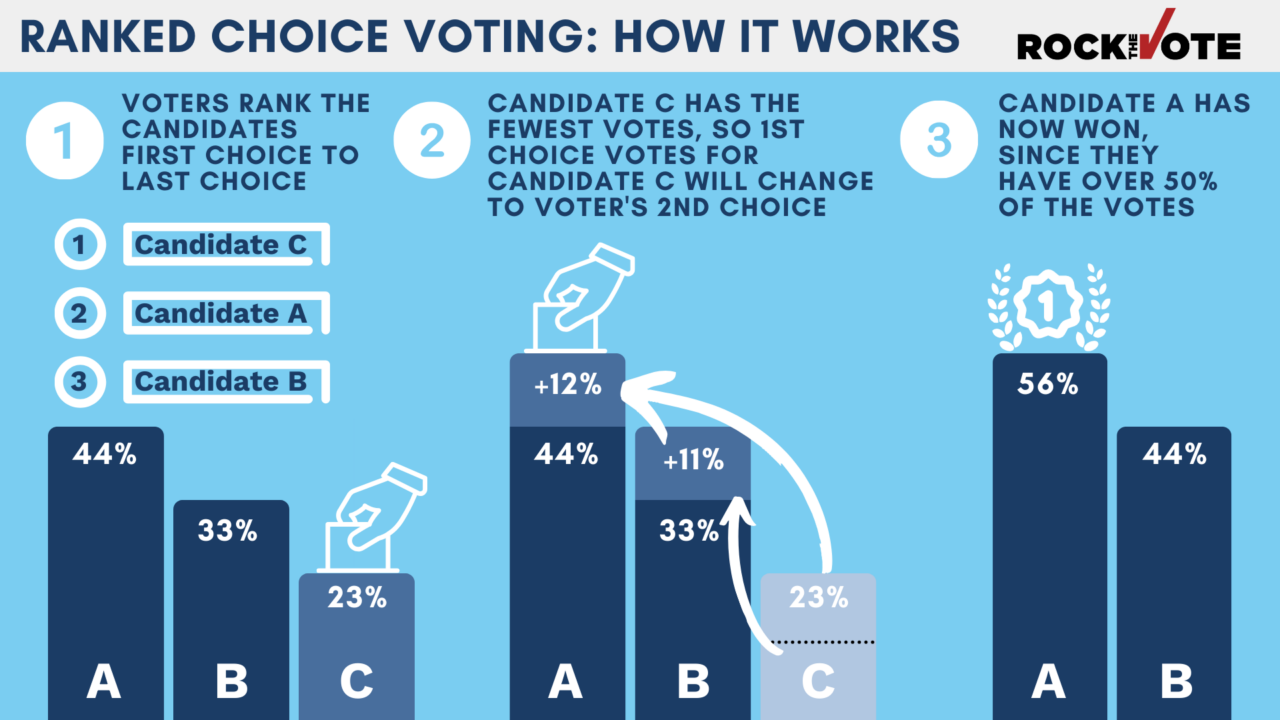
Most elections will result in a single winner, so this method removes in sequence the least popular candidates until a candidate has a vote total that exceeds 50% of ballots received. In one DC election, however, there will be two winners: the At-Large councilmember election.
The authors of the initiative did not overlook this fact. The legislation provides in Sec. 1-1001.08a (e) that: “In any general election contest for At-Large members of the Council, in which there shall be 2 winners, each ballot shall count as one vote for the highest-ranked active candidate on that ballot.” Steps for tabulation read similarly to the above except if there are two or fewer candidates that have not been eliminated; in that case, those two candidates are elected and tabulation ends.
This system should raise alarm bells. DC’s Home Rule Charter reserves two of the four At-Large Council seats for “non-majority parties,” meaning that in each election cycle where two seats are up, only one can go to a Democrat. In practice, this system typically means registered Democrats leave the party and become independents shortly before the election filings. A normal biennial DC general election will have one Democrat, one Republican, one Statehood Green candidate (each of whom won their respective party’s June primary), and one or multiple independent candidates who filed to run.
Under previous law, DC voters in the general election had two votes to elect two At-Large councilmembers. The two candidates with the most votes won a seat. Under the new system, all of these candidates will still compete in the same election, but now voters will rank them in order of preference on their ballot. Voters will no longer get two votes. This is because, similar to RCV for a single-winner election, the lowest vote getter is eliminated, and their voters’ ballots are redistributed based on their next ranked-choice preference. For multi-seat RCV, the common and standard method used across other cities and countries is some form of single transferable vote, a method in which the surplus votes that a candidate receives (after they reach the 50%+1 election threshold) are transferred to each voter's second-favorite candidate. Instead of using this method, DC has chosen the single-winner version and applied it twice in a row.
In a place where the vast majority of people are registered Democrats, this creates a major issue for workers, unions, progressives, the Left, and the general application of democracy in DC.
In 2024, over 240,000 voters used one of their two votes for the Democrat for At-Large. That means around 74% of voters cast their ballot for the Democrat with one of their two votes. Seventy-five percent of DC voters are registered Democrats. These voters will easily elect their chosen candidate, the Democrat, to capture one of the At-Large seats. But because the law only moves votes from eliminated candidates, all of the votes for the Democratic candidate will be locked with that candidate. In other words, despite there being two seats, the hundreds of thousands of working-class people that vote for the Democrat in the At-Large election will not have a say in who wins the other, non-Democratic Council seat. Only voters who do not rank the Democrat first will decide the second seat, meaning that the second seat will be determined by Republicans, conservative-leaning independents, a small number of liberal or left independents, and anyone who leaves the Democrat out of their top rankings.
Under the new election system, the race for the second At-Large seat becomes a fight over the non-Democratic vote only, a small minority of the electorate that is disproportionately whiter, wealthier, and more conservative3. Democratic voters, including most union households, lose their power to choose who fills that seat. Effectively, 75% of voters (the Democrats) are allocated 50% of the At-Large seats, while the 25% non-Democratic voters that cover a range of different political beliefs are also allocated 50% of the At-Large seats. This is extremely anti-democratic (with a small d), essentially giving Democrats fewer real votes than their non-Democratic neighbors.
This reform hurts workers and organized labor. Historically, winning the second seat has always required support from Democratic voters who support pro-worker independents and Statehood Green candidates with their second vote. By making candidates consider the full, largely Democratic District voting population, the At-Large election system rewarded candidates that made concessions to labor and other Democratic voter priorities in order to win the second seat. This is not to say that the At-Large candidates have always been champions of the working class, but they did have to at least court the votes. Now, the roughly 25,000 reliable Republican voters — plus another 25,000 or so conservative independents and a bloc of moderate independents that lean anti-labor on economic issues — can form a winning coalition for a right-leaning candidate.
The current implementation of ranked-choice voting will disenfranchise large swaths of the District. To restore voters’ power to fully influence the outcome of the At-Large elections, DC will need to either revert back to the previous voting system for the At-Large elections or switch to the multi-seat forms of RCV used nearly everywhere else: single transferable vote. Single transferable vote is used in city elections in Cambridge, Massachusetts; Eastpointe, Michigan; Palm Desert, California; Albany, New York; Minneapolis, Minnesota; St. Paul, Minnesota; St. Louis Park, Minnesota; Portland, Oregon; and Portland, Maine.
Unfortunately, it may be unrealistic to expect any change before the 2026 elections. During the April 11 Ward 1 Democratic Forum, outgoing Ward 1 Councilmember Brianne Nadeau was made aware of the issue and said that she would look into it, but with recess looming there is no guarantee that the legislation will be updated4. An amendment would require the convening of the Committee on Executive Administration and Labor, which is unlikely to happen before summer recess. The only other alternative would be to pass a subtitle amending this legislation through the Budget Support Act. Given the sheer number of priorities raised in the budget, and guaranteed fights to come around the Pay Equity Fund, Emergency Rental Assistance Program, and government worker pay freezes, it is unlikely that attention will be given to addressing an issue so seemingly minor and esoteric.
Given the state of play, the Left-labor coalition only has one shot at winning the second At-Large seat: build a ~65,000- to ~85,000-person voting bloc that can be persuaded to not rank the Democrat first, persuade some Democratic voters to rank the Democrat outside of the top two so that their vote says “in play” beyond the second or third rounds, and coordinate messaging — including critically important shared ranking instructions — across labor, progressive, leftist, and other electoral groups. This will require a high degree of discipline and unity and a good deal of forward planning and early action. If labor and the Left fail to pull together strategically, the second At-Large seat is likely to go to a candidate that opposes priorities such as worker and tenant rights and protections, social housing, universal childcare, and decarceral approaches to public safety.
The odds are near insurmountable. As a result, the current implementation of ranked-choice voting in DC may very well lead to a Council that is one councilmember less likely to support the District's working class — a loss that can hardly be afforded in an already conservative-leaning Council. In the short term, we on the Left must organize to push the Council in a progressive direction, and we must elect our endorsed socialist candidates to the Council and the mayor’s office. In the longer term, progressive groups must be more strategic and thorough in our reforms and more willing to carefully critique proposed initiatives. If we are not, the potential consequences will ripple far beyond Election Day.
What can be learned from past elections and voter registration data about the potential "non-Democrat" votes:

