

Christine K is a member of the Metro DC Democratic Socialists of America.
SINCE ELEANOR HOLMES NORTON announced that she would retire from her position as Washington, DC’s congressional delegate, the race to replace the seat she has held since 1991 is already on course to be among the most expensive in DC history. One candidate leads the field in fundraising, raising more than $843,000 between August 1 and December 31, 2025 (including $170,000 from donors with a history of giving to Donald Trump and other Republican candidates): Ward 2 Councilmember Brooke Pinto.
It may be surprising that this race is already garnering so much money and attention, especially considering that DC’s congressional delegate cannot vote in Congress (the reality underpinning the popular slogan “taxation without representation”). However, with the barrage of threats to DC Home Rule and the District occupied by 2,400 National Guard troops and other federal agents under the “Safe and Beautiful Task Force,” having a strong DC advocate in Congress has never been so important. Despite the lack of voting power, DC’s congressional delegate can introduce legislation, serve on and vote in committees, speak on the House floor, and offer constituent services. These responsibilities present opportunities to speak on behalf of DC residents, defend the District’s autonomy, and advocate for statehood.
So how did a woman from Connecticut with substantial Republican backing — who did not vote in DC until 2020 (the same year she was elected as councilmember) — become a frontrunner for this position?
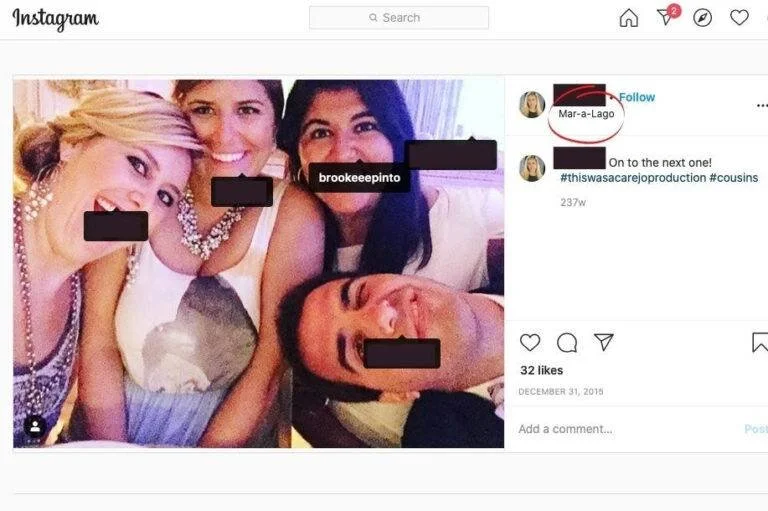
Brooke Pinto was born in Greenwich, Connecticut, the daughter of James Pinto, a private equity executive who heads MVC Capital. After completing a degree in Business and Hospitality Administration at Cornell, she moved to DC in 2014 to attend Georgetown Law School. In 2015, her parents endowed the school with a fellowship in their name. Later that year, Brooke and her family attended an exclusive New Year’s Eve celebration at Donald Trump’s Mar-a-Lago resort, during which Trump, then the Republican presidential frontrunner, promoted his campaign and pledged to “Make America Great Again” not long before the ball dropped.
After graduating from Georgetown in 2017, she clerked for a federal judge and then interned in the Office of the DC Attorney General under Karl Racine. In 2019, she registered to vote in DC and then set her sights on the Ward 2 Council seat. She received endorsements from Senator Richard Blumenthal of Connecticut, with whom she had interned for a summer, as well as from then-Representative Joe Kennedy III of Massachusetts. Over the past decade, James Pinto has donated more than $12,800 to Blumenthal and more than $7,800 to Kennedy.
Unlike the rest of the candidates running to represent Ward 2, she did not participate in the DC Fair Elections Program, which provides 5:1 public matching for campaign contributions made by DC residents. Because she did not participate in this program, she could accept larger donations from outside the District, allowing her to raise $7,000 from relatives, with her mother and father maxing out their campaign contributions. Other notable contributors to her campaign included several Kennedys. By opting out of the DC Fair Elections program, she could also personally contribute $45,000 to her own campaign. This figure may seem excessive for a then 28-year-old public servant only recently out of law school, but Pinto had a family inheritance at her disposal.
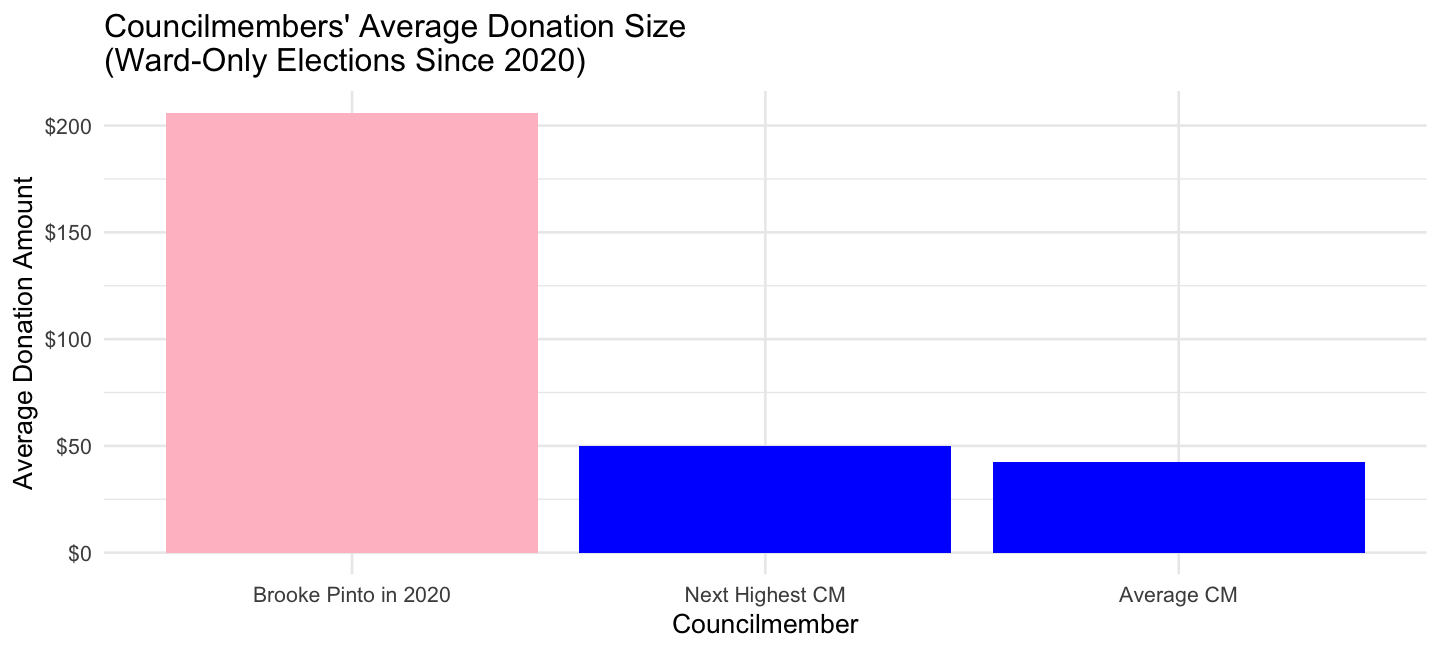
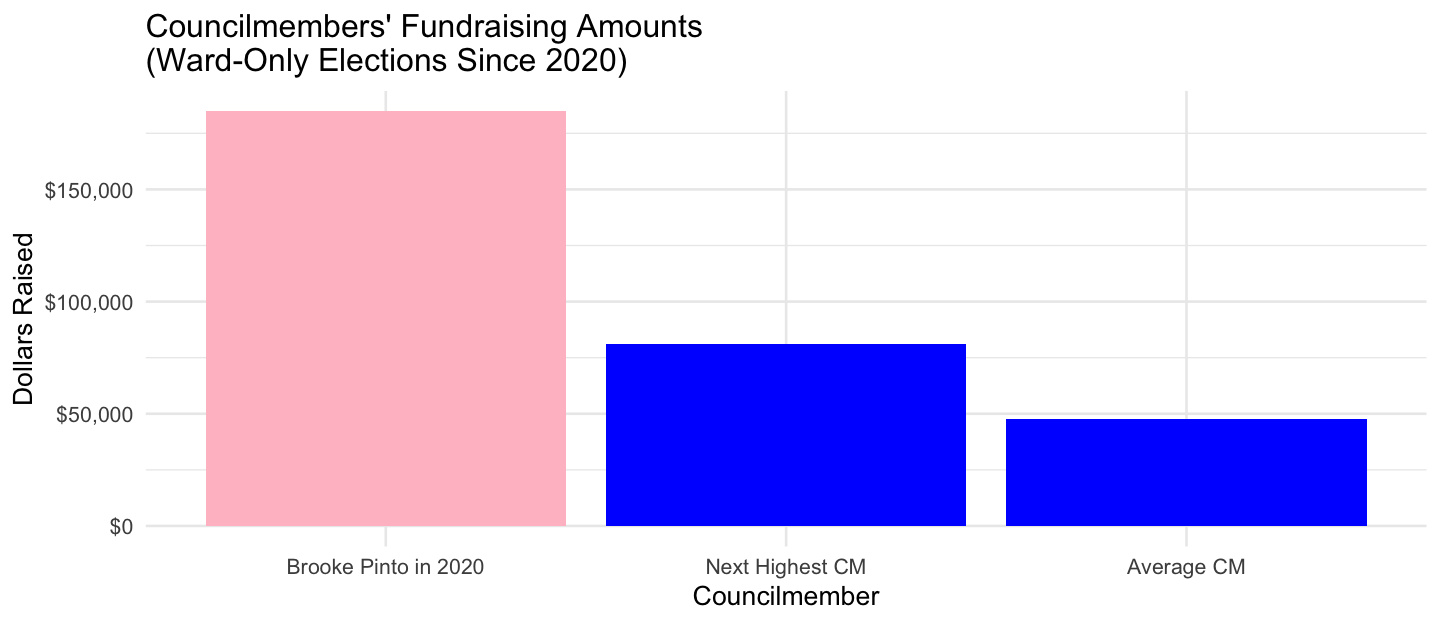
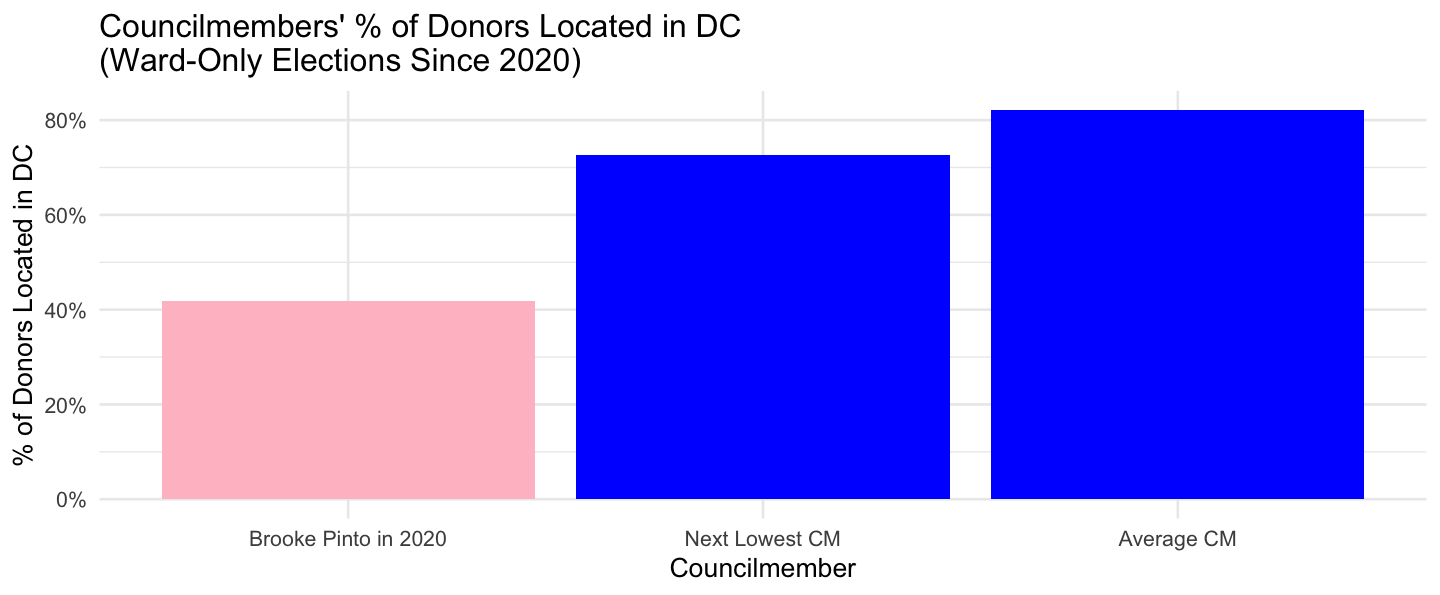
When considering ward-level elections from 2020 to now, Pinto’s 2020 campaign had the highest average donation size, more than four times greater than that of the average councilmember (see Figure 1); the most dollars raised (see Figure 2); and the lowest share of donors located in DC (see Figure 3).
Over the years, there have been multiple complaints filed against Pinto, who has acted as her own campaign treasurer, for alleged violations of campaign finance laws or misuse of public funds. While she was eventually cleared, one complaint alleged that her campaign’s use of 1300 Q St. NW as its headquarters may constitute an excessive contribution. Pinto listed the address as her official campaign headquarters on an AFL-CIO questionnaire, but then claimed she quickly abandoned the idea and conducted the campaign remotely due to the ongoing pandemic. However, her mother, Dale Pinto, had already signed a $5,500/month lease for the property through the end of June, and the house had been decorated with Pinto’s campaign balloons.
In 2021, Pinto once again found herself embroiled in a campaign finance controversy. On December 6, Pinto supporters were invited to a fundraiser where they could contribute up to $500 each to “help Brooke retire her 2020 campaign loans.” The event ultimately raised $21,000. However, it is illegal in DC for elected officials to hold fundraising events to offset personal campaign debts more than six months after the election.
Pinto has maintained she has done nothing wrong in these instances and has avoided facing any consequences, but complaints against her continue to pile up. More recently, she has been accused of misusing public funds after spending $85,000 of DC taxpayer money to send a mailer to ~97,750 residents throughout all wards of the District (not just her constituency in Ward 2). A few days after this DC-wide self-promotion of questionable legality, Pinto announced her run for Holmes Norton’s seat. The mailer was focused primarily on the work of her Judiciary Committee.
On December 21, 2022, DC Council Chairman Phil Mendelson appointed Pinto as chairperson of the Committee on the Judiciary and Public Safety. In January 2024, she introduced the Secure DC Omnibus Amendment Act of 2024, with the aim of a “safer and more secure DC.” The bill has received numerous critiques from civil rights organizations, including the Council Office of Racial Equality, American Civil Liberties Union-DC, The Sentencing Project, Civil Rights Corps, Who Speaks for Me?, Metro DC Democratic Socialists of America, Stop Police Terror Project DC, Open City Advocates, and Harriet’s Wildest Dreams. These organizations have denounced many of the bill’s provisions as punitive, draconian, racist, and, in some cases, unconstitutional.
Secure DC created so-called “drug-free zones,” which authorize the chief of the Metropolitan Police Department (MPD) to temporarily designate a specific area within which MPD officers are permitted to force groups of people to disperse if they suspect they are there for illegal drug activity. Drug-free zones disproportionately target Black and brown communities and have drawn comparisons to racist stop-and-frisk policies, which were found unconstitutional and since discontinued in New York City. The ACLU has described drug-free zones as “ineffective, racially discriminatory, and unconstitutional.” In fact, DC Council previously repealed drug-free zones in 2014, in part due to concerns over constitutionality.
Another provision of Secure DC that has concerned racial justice organizations is the expansion of pretrial detention, which allows police to jail legally innocent individuals charged with certain crimes while they are awaiting trial. Pretrial detention has a destabilizing effect on people’s lives, separating them from children and families, and can lead to loss of jobs, housing, and access to healthcare. Despite arguments otherwise, there is no evidence to suggest that pretrial releases are a major driver of crime in DC, given that 92% of people on pretrial release are not rearrested, and only 1% are rearrested for a violent offense. Evidence actually suggests that longer stays in pretrial detention are associated with more new arrests and more new violent arrests.
Additional measures in Secure DC that have sparked concern include a crackdown on Metro fare evasion, the reestablishment of a mask ban (this ban allows DC residents to be arrested if a police officer believes they are masking to avoid identification), and permitting police to use neck restraints and engage in high-speed chases.
Pinto’s original proposal contained even more extreme measures that were removed thanks to amendments from other councilmembers, including Janeese Lewis George, Kenyan McDuffie, and Trayon White. For example, the version initially introduced by Pinto would have permitted MPD to remove cops’ names and badge numbers from public notices for police misconduct hearings, a major blow to police transparency.
In 2025, Pinto introduced and passed Peace DC, doubling down on her tough-on-crime reputation. Among other provisions, this bill extended the pretrial detention measures of Secure DC and expanded youth curfews. Peace DC also included the Residential Tranquility Amendment Act, which limits residents’ First Amendment rights and increases police’s ability to arrest protesters by banning sound-amplifying devices in residential areas from 7pm to 9am. Undeterred, protesters have continued to gather outside Pinto’s house to demonstrate their anger with her policies and demand accountability.
Despite the criticism, Pinto is proud of Secure DC and Peace DC, taking credit for crime reduction and improved public safety in her campaign materials, on podcasts, and in Fox News interviews. There is no evidence that directly links these decreases to the oppressive measures imposed by Secure DC and Peace DC, and DC’s crime data largely reflect trends seen nationally in the years following COVID.
Neighboring Baltimore has seen even more dramatic drops in crime — with city leaders taking a very different tactic. In 2021, Mayor Brandon Scott developed a holistic strategy towards public safety, which treats gun violence as a public health crisis. Under his leadership, Baltimore implemented community-based and trauma-informed approaches, utilizing outreach workers, community “moral voices,” and group “call-ins,” rather than police officers alone to address violent crime. Scott has also emphasized the importance of supporting communities through job programs and apprenticeships, and investing in schools, recreation centers, libraries, pools, and playgrounds. In 2025, Baltimore recorded its lowest number of homicides in almost half a century, with both homicides and shootings down by roughly 60% since his program began in 2021.
While Pinto has been vocally critical of Immigration and Customs Enforcement, her policies massively increased the power of law enforcement in DC, thus paving the way for the unchecked abuses of the federal task force. Despite Pinto’s resistance to repeated calls for a dedicated hearing on MPD’s well-documented collaboration with ICE, many public witnesses showed up to testify at general public safety and oversight hearings held by her Judiciary Committee to demand she take action to end this unlawful cooperation.
Though she was seen mostly scrolling her phone, crossing her arms, and rolling her eyes during public testimony, sustained pressure from activists has forced Pinto to at least attempt to address widespread concern. In response, she wrote a letter to MPD asking for clarity and passed an emergency bill requiring the public release of MPD body-worn camera recordings when there is a use of force by a federal agent, as well as tracking the names of all officers involved in these incidents. For many, these measures seem too little too late, considering the harm that federal agents have already caused with little end in sight.
With the Democratic primary election on June 16, many DC residents are preparing to vote for the candidate who will likely become their next congressional delegate. This position will provide the winner with an important national platform, which they should use to stand up for DC’s most vulnerable communities against the violence of the federal task force and the other mounting attacks on DC’s autonomy. The question voters must ask themselves is whether this wealthy woman from Connecticut, who has allegedly played fast and loose with campaign finance laws, who has received ample support from GOP donors, whose proudest accomplishments include a massive expansion of police and carceral power, and who scrolls her phone and rolls her eyes when DC residents point out any of this, is really the person for the job.


