
Matthew B is a member of the Metro DC Democratic Socialists of America
A FREQUENTLY OVERLOOKED FACT about the American Civil Rights Movement of the 1950s and 1960s is that many of its most influential leaders were socialists, leftists, and radicals. This amnesia is no accident. The Black radical tradition has often been suppressed by the political establishment and even those in the mainstream Black political space, who deny its radical power and downplay its history — or even worse, appropriate this radical tradition into a milquetoast centrism, “Black excellence,” or “Black capitalism.” The powers that be often water down the history of Black socialism to force it into the American exceptionalist project: focusing on individuals rather than movements, or uplifting the elements of the movement that make people comfortable while ignoring its more subversive and revolutionary aspects. Whether it’s through movies like Rustin, documentaries like I Am MLK Jr., or in speeches like President Barack Obama’s on the 50th anniversary of the march on Selma — in which he framed the Civil Rights Movement as part of an American mythos — the movement’s radical character has been discarded in order for its history to be appropriated by conservatives, moderates, and liberals for decades.
This is a desecration and perversion of basic history, as many figures in the Civil Rights Movement openly endorsed socialism. This historical fact is one that the Democratic Socialists of America should look to as a potential pathway to organizing all facets of the American working class, especially as the organization continues to grow with every passing day.
There is a lot to be said of the period before the 1950s and ‘60s, when many influential Black leaders were open leftists or espoused leftist thought. This included figures like W. E. B. Du Bois, Paul Robeson, Claudia Jones, Langston Hughes, Lucy Parsons, and even Hubert Harrison, who was a pioneer in combining race and class consciousness. But the main focus of this article is the era of the Civil Rights Movement. This is the point in history most frequently referenced by present-day political figures who, if they lived during the time, would likely be rabidly opposed to the movement and its leaders.
There is no better example of this than Martin Luther King. Every year on the third Monday of January, we see conservatives, liberals, and moderates appropriate the legacy of Dr. King and cherry-pick his quotes just as they cherry-pick parts of the Bible. While many share excerpts from King’s “I Have a Dream” speech, very few share the quote: “Capitalism has outlived its usefulness. It has brought about a system that makes necessities from the masses to give luxuries to the classes.”
Even before his rise to prominence, King showed sympathies and even support for socialism. In a 1952 letter to his wife, Coretta, he wrote, “I imagine you already know that I am much more socialistic in my economic theory than capitalistic.”
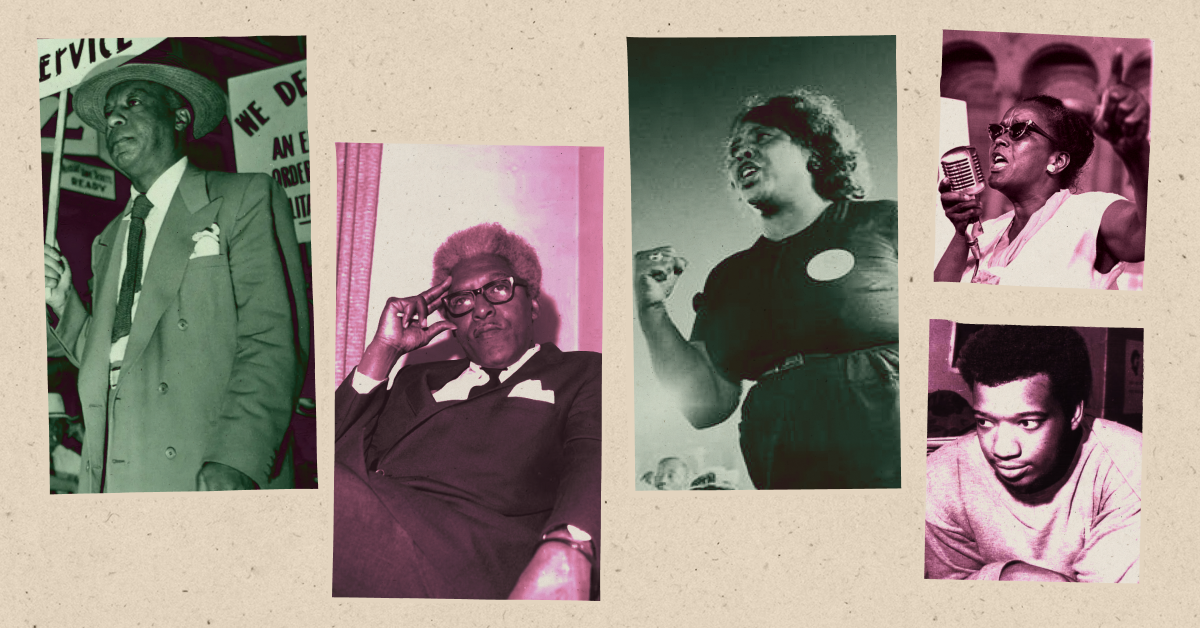
In the early days of the Civil Rights Movement, King surrounded himself with many open socialists like Bayard Rustin, A. Philip Randolph, Ella Baker, and Fannie Lou Hamer. Despite never identifying as a Marxist, likely due to his role as a Baptist minister and his belief that Christianity was at odds with Marxism, King fully acknowledged the class struggle. In fact, he directly told the New York Times, “In a sense, you could say we are engaged in the class struggle.”
In his final years, King became increasingly active in the labor aspect of the movement and even more explicit in his opposition to capitalism. This was clear in his criticism of the Vietnam War, which he decried as an example of the three evils of racism, militarism, and capitalism. And it was even clearer in the days leading up to his assassination: King traveled to Memphis to support striking sanitation workers and even envisioned the Poor People’s Campaign, which would focus on economic inequality. He put it bluntly in 1966: “Something is wrong with the economic system of our nation. Something is wrong with Capitalism. Maybe America must move toward a democratic socialism.”
In King’s last book, Where Do We Go From Here? Chaos or Community, he described the tension between individualism and collectivism — a tension especially felt during the height of the Cold War, which pitted the capitalist framework of the United States against the communist framework of the Soviet Union. He talked about a “socially conscious democracy,” which, while indicative of the era’s prevailing attitudes towards communism, is in many ways the essence of democratic socialism.
“Truth is found neither in traditional capitalism nor in classical communism,” he wrote. “Each represents a partial truth. Capitalism fails to see the truth in collectivism. Communism fails to see the truth in individualism. Capitalism fails to realize that life is social. Communism fails to realize that life is personal. The good and just society is neither the thesis of capitalism nor the antithesis of communism, but a socially conscious democracy which reconciles the truths of individualism and collectivism.”
Dr. King is rightly memorialized as a visionary racial justice leader. But his persistent advocacy for working-class people and his years-long critique of capitalism are less enshrined in popular history. Nowhere is this clearer than in the mainstream retelling of one of King’s most famous campaigns: the March on Washington.

The famous 1963 March on Washington was born from the vision of two socialists: A. Philip Randolph and Bayard Rustin.
Learning from the “father of Harlem Radicalism,” Hubert Harrison, Randolph was probably the most well-known Black socialist in the United States for almost 50 years. He was a member of the Socialist Party of America and founded and coedited the Harlem newspaper The Messenger, which initially advocated for socialist politics. Randolph was also an incredibly effective strategist for racial justice. He helped pressure President Franklin D. Roosevelt to sign Executive Order 88021, which desegregated parts of the American military. The basis of that pressure, which Roosevelt acknowledged, was the power of a potential March on Washington. Randolph had planned such a march for July 1, 1941. But it wouldn’t come to fruition until 1963, the year that marked the centennial of the Emancipation Proclamation. Randolph was helped by Bayard Rustin, who opposed Randolph’s decision to cancel the original march after Roosevelt signed Executive Order 88021.
Rustin has a more complicated legacy. Later in life, he would support American anti-communism and advocate for the steadfast political alignment between Black Americans and the Democratic Party. However, Rustin was a staunch socialist. It was his identity as a socialist and an openly gay man that made Rustin play behind the scenes in the Civil Rights Movement during the height of the Red Scare and a time of widespread homophobia. But despite being sidelined, his socialist convictions were a core part of his work as an organizer in the movement.
Randolph and Rustin’s socialism was borne out during the march itself, particularly visible in the presence of fellow trade unionists. The role of organized labor in the Civil Rights Movement has often been underappreciated: the March on Washington’s full title was the March on Washington for Jobs and Freedom, and one of its main goals was to fight against economic inequality. The march even gained the support of the United Automobile Workers union, whose president, Walter Reuther, marched alongside King, Randolph, and others on that famous day in August 1963.
The inseparable nature of racism and capitalism would animate future initiatives of the movement and its leaders, bringing the radical character of their campaigns into the spotlight.
Through public persuasion and peaceful protests, King, Randolph, Rustin, and their comrades were successful in pushing Presidents John F. Kennedy and Lyndon B. Johnson to help pass the Civil Rights Act of 1964 and the Voting Rights Act of 1965. These successes revealed a crucial lesson still relevant today: idealistic causes are not just morally right, they are practical and winnable.
Recognizing that these victories were only the beginning, movement figureheads soon started a new project: A Freedom Budget for All Americans. This was seen as the main priority of many civil rights leaders, and its focus on economic justice for Black Americans made radical, necessary demands that ring true to this day.
In his book, A Freedom Budget for All Americans: Recapturing the Promise of the Civil Rights Movement in the Struggle for Economic Justice Today, socialist thinker Paul Le Blanc saw the platform as a “full and final triumph of the Civil Rights Movement, to be achieved by going beyond civil rights, linking the goal of racial justice with the goal of economic justice for all people in the United States.”
The seven goals of the Freedom Budget were: 1. Providing full employment for all who are willing and able to work, including those who need education or training to make them willing and able. 2. Assuring decent and adequate wages for all who work. 3. Assuring a decent living standard to those who can not or should not work. 4. Wiping out ghettos and providing decent homes for all Americans. 5. Providing decent medical care and adequate educational opportunities for all Americans. 6. Purifying the air and water, and developing transportation and natural resources, and 7. Uniting sustained full employment with sustained full production and high economic growth.
These goals almost read as a democratic socialist platform. The Freedom Budget went beyond the “Buying Black” approach that some Black Americans try to preach even today; it aimed to fulfill the universal needs of the working class. The Freedom Budget was ahead of its time, as the proposed Second Bill of Rights by Franklin D. Roosevelt was back in 1944. Today, we see echoes of its demands in proposals from democratic socialists like Senator Bernie Sanders, Representative Alexandria Ocasio-Cortez, and New York City Mayor Zohran Mamdani.
Many of the Civil Rights Movement’s most famous figures were men. But as is the case throughout history, the most underappreciated people in both the Civil Rights Movement and the class struggle were Black women — the backbone of the movement. They often worked behind the scenes and were undervalued, confronted by the two-headed monster of racism and sexism.
However, although they did not always receive the praise given to men like King and Randolph, there were countless women in the movement who were openly supportive of socialism and/or other leftist trains of thought. Some of the highest-profile examples are Ella Baker, Fannie Lou Hamer, and Angela Davis.

Both Baker and Hamer were longtime fighters in the struggle for civil rights, and both were supportive of anti-capitalism. Baker supported “family socialism,” actively worked with socialists, and espoused the value of liberating the working class. She staunchly opposed civil rights groups that gave in to the McCarthyist campaigns against left-leaning groups that defined the era. Hamer cofounded the Freedom Farm Cooperative, which assisted Black farmers in fighting against poverty and sharecropping. Worker cooperatives, regardless of field, are an example of the basis of socialism — workers own the means of production and exercise true workplace democracy — and one can argue that the Freedom Farm Cooperative inspired future Black cooperatives like Cooperation Jackson.
Baker and Hamer walked alongside the male civil rights leaders mentioned in this article. However, they both faced pushback due to a common inequity found in Black activist spaces: while the members of the movement were either a plurality or majority Black women, leadership was almost exclusively Black men.
Arguably the most well-known Black woman activist of her time was Angela Davis, who is a stalwart of the Black leftist tradition. Davis is perhaps the most famous example of the radicalism of the racial justice movement: one of her most defining traits, from the late 1960s into the 1980s and beyond, was her staunch communism. What often goes overlooked is that Davis’s communism was part of the long tradition of Black women — and Black Americans in general — who had been supportive of and/or identified with the communist movement. But that’s an article for another time.
As the struggle for racial justice moved into the late 1960s and 1970s, and figures like Martin Luther King and Malcolm X were assassinated, new radical political groups emerged — groups unafraid to declare their belief in revolutionary socialism. The most famous was the Black Panthers, a Marxist organization that preached against capitalism and racism. The Panthers held the view that is held by most leftists: that you can’t separate class from race.
The Black Panthers were feared by men like then-California Governor Ronald Reagan and Federal Bureau of Investigation Director J. Edgar Hoover — the latter described the group as “the greatest threat to the internal security of the country.” As governor, Reagan signed the Mulford Act specifically to disarm the Black Panthers, who conducted armed patrols around Oakland to protect Black residents from police violence.
However, this was only a small part of why the Black Panthers were feared by the political status quo. Another reason was their radical political positions. There is no better example than their Ten-Point Program.
The Ten-Point Program articulated a potential socialist vision for the United States. Probably the most bluntly stated point was the third, which called for “an end to the robbery by the capitalists of our Black and oppressed communities.” Likely the most impactful and famous part of the Ten-Point Program was the final point, which states: “We want land, bread, housing, education, clothing, justice, peace, and people’s community control of modern technology.” The 10th point was exemplified in the Panthers’ Free Breakfast for Children program, which fed thousands of children across American cities and helped lead to the creation of the United States Department of Agriculture School Breakfast Program. This was envisioned by the Black Panthers’ founders, Huey Newton and Bobby Seale, as an affirmation of their leftist convictions, and the first program was established in Saint Augustine’s Episcopal Church in West Oakland, California.
One can see the byproduct of the Panthers’ breakfast program almost 40 years after the original Black Panther Party was disbanded. Across the United States, the “radical” practice of giving out free breakfasts and lunches to children can be found in states like Minnesota, which passed a law providing free and universal breakfast and lunch for K-12 students in 2023.
However, the Black Panthers’ success made them a target of COINTELPRO, a covert FBI operation that sabotaged many left-wing social movements like the Black Panthers, Students for a Democratic Society (SDS), the Student Nonviolent Coordinating Committee (SNCC), and many anti-Vietnam War protestors. Individual victims of COINTELPRO included Martin Luther King, Muhammad Ali, James Baldwin, Assata Shakur, Huey Newton, Jean Seberg, Ernest Hemingway, and Malcolm X.
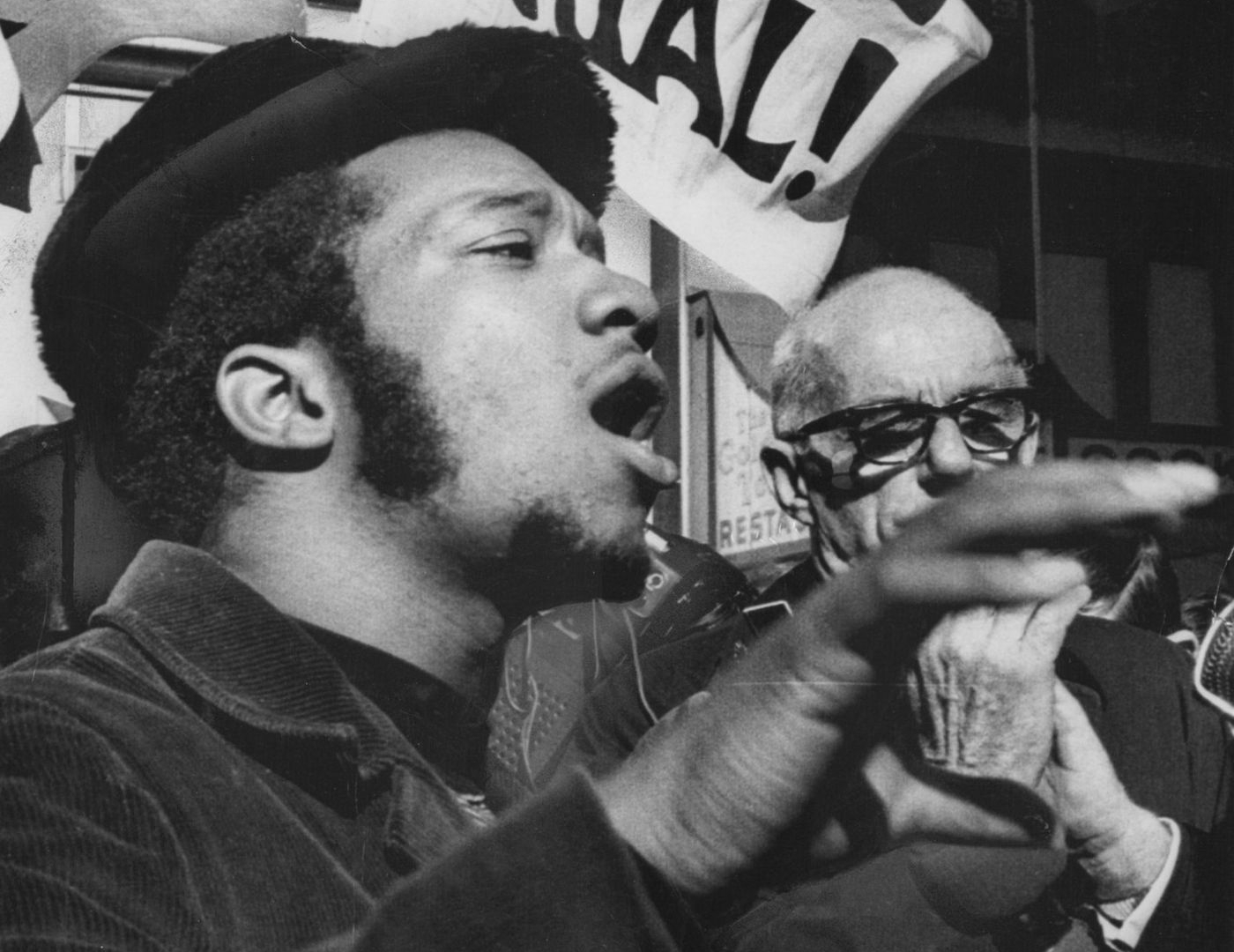
Arguably the biggest victim of COINTELPRO was Fred Hampton, the chairman of the Illinois chapter of the Black Panther Party, who Hoover thought of as the “Black Messiah.” Hampton boldly claimed, “We’re not gonna fight capitalism with Black capitalism. We’re gonna fight capitalism with socialism. Socialism is the people. If you’re afraid of socialism, you’re afraid of yourself.” Hampton supported a Rainbow Coalition of working-class Americans of different backgrounds, united in the front against racism and capitalism and advocating for class solidarity and socialism. This included allying the Black Panthers with the Young Patriots and the Young Lords.
That was part of the reason why the FBI, along with the Chicago police, murdered him on December 4, 1969. There is nothing more dangerous to the ruling class than a diverse group of working-class people standing up to power.
Over the following decade, the FBI was largely successful in stomping out the leftist elements of the Civil Rights Movement, and thanks to the mainstream political establishment, this radical history started to be forgotten. Many of the remaining living civil rights leaders lost their radical edge and moved towards the political center. Today, too many better-known Black political figures like Barack Obama, Rep. James Clyburn, and Rep. Hakeem Jeffries constantly appropriate the legacy of the movement while appealing to centrism: supporting neoliberal policies, advancing militarism, and criticizing left-wing or progressive policies like Medicare for All.
As we commemorate Black History Month in the second year of the Trump regime, with growing tolerance of white supremacy from the right and an ineffective response from centrists and liberals in combating white supremacy and fascism, we should remember that the accomplishments of the Civil Rights Movement were made by socialists. Black members of the DSA should openly take pride in that and use it as inspiration for the organization.
In February, the DSA celebrated having more than 100,000 members in good standing, an accomplishment showing not only discontentment with the political status quo among a growing number of Americans but also the continued growth of an anti-capitalist movement in the United States.
But ultimately, socialists should not be content with this achievement. DSA must continue to organize and expand until our socialist vision is realized.
While there are many differing approaches to building socialist power, members of DSA can learn from the lessons of the Civil Rights Movement by making the organization into a modern Rainbow Coalition, where working-class people from different backgrounds unite under class solidarity. The DSA should pursue a socialist Freedom Budget in the spirit of the Civil Rights Movement: a program that guarantees universal healthcare, a welfare state, free education, a federal jobs guarantee, turning the minimum wage into a living wage, a universal and unconditional basic income, slashing the military spending, free and universal school lunches and breakfast, affordable housing, worker cooperatives, and a transition from capitalism to socialism. Furthermore, the DSA should define the basis of democratic socialism as a socially conscious democracy that reconciles the truths of individualism and collectivism.
Most importantly, the DSA must reclaim the suppressed history of the Black radical tradition to bring more working people to our cause. By doing so and by elevating Black members of the organization, we socialists can dispel the claim that DSA is “too white” or an organization where Black Americans are not included.
As Martin Luther King said in a speech to the Negro American Labor Council in 1961, “Call it democracy, or call it democratic socialism, but there must be a better distribution of wealth within this country for all God’s children.” The DSA certainly calls this a part of democratic socialism, and as Black History Month comes to a close, we can and must commit to making Dr. King’s socialist vision a reality.