
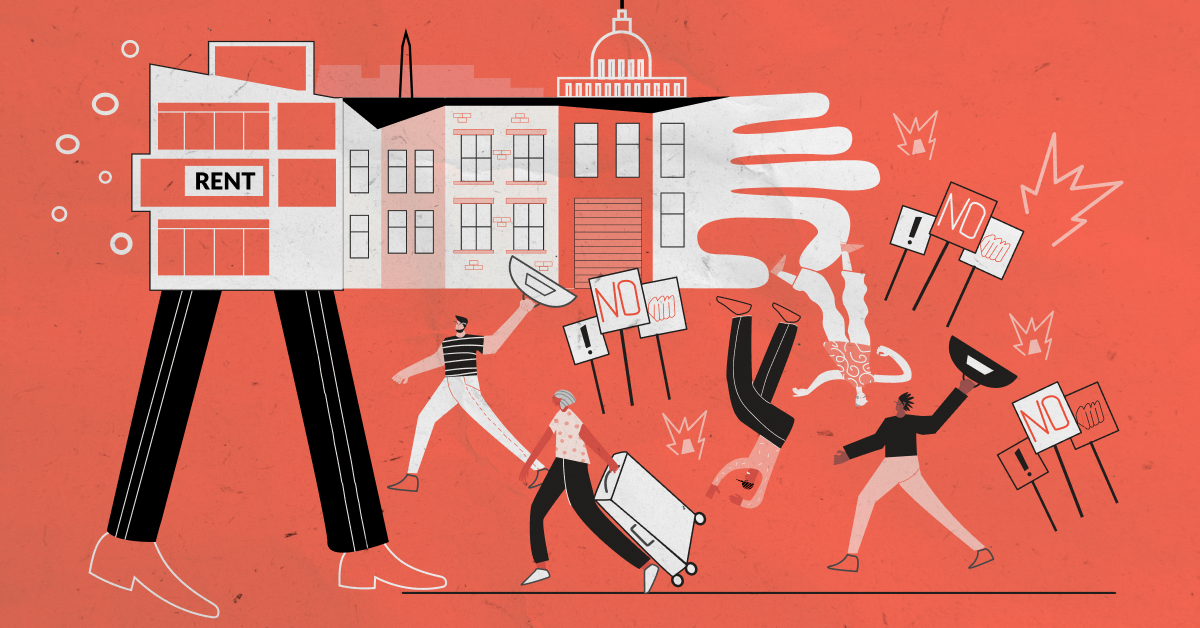
ON SEPTEMBER 21, 2025, the DC Council passed an amended RENTAL Act. This legislation was initially unveiled in February 2025 by Mayor Muriel Bowser to much fanfare. Her justification, which the Council appears to have agreed with, is that the legislation “Protects DC’s Existing Affordable Housing” and “Ensures DC Can Build More Housing in the Future” by making it easier to evict tenants and by stripping tenants of their Tenant Opportunity to Purchase Act (TOPA) rights. While the more progressive faction on the Council was able to remove some of the worst-of-the-worst elements from the TOPA exclusions, and the Council did provide some eviction protections for victims of domestic violence, the legislation as passed will be devastating for residents in the District.
This bill is large and incredibly dense, and intentionally so. The mayor and the majority on the Council do not want tenants to understand how their rights have changed. At its heart, the RENTAL Act is primarily about one thing: making DC friendlier to landlords, developers, and capital. Specifically, this legislation massively loosens eviction protections in the name of public safety and building solvency, dramatically reduces eviction timelines, and strips TOPA rights from thousands of tenants, including those in newly constructed buildings and those that live in properties with two to four units.
The two to four exemption is particularly egregious, as it was introduced as an ill-conceived and poorly constructed amendment by pro-displacement Councilmember Anita Bonds on the second read of the bill. The amendment was so badly drafted that the Council was forced to reconvene a third, then fourth time on the RENTAL Act for the sake of clarity and legal coherence. During that final meeting, despite Bonds’s insistence that the amendment is “not last minute [but] the result of thoughtful consideration” (12:43), she admitted under questioning that she had “not talked with anyone” (36:38) from two- to four-unit buildings who exercised their TOPA rights. She asks for “great attention” (13:32) to be given to property owners, yet she and others on the Council refused to give any consideration for the residents in these units.
This piece of legislation is best understood as the culmination of years of effort by landlords, developers, and their lobbying arms to shift narratives and priorities in DC. It is no exaggeration to say that the bill is the largest setback for tenants in the District since the establishment of home rule. Landlords have successfully deployed sob stories about small “mom-and-pop” landlords held financially hostage by “professional tenants” and threats of capital strike to undo years of carefully constructed tenant protections. As I and my coauthor Ray Valentine charted in our article about TOPA, the first wave of attacks successfully stripped renters in single-family homes of their TOPA rights in 2018. In 2020, the legislative effort to pass the “Rent Stabilization Program Reform and Expansion Amendment Act of 2020” by the Reclaim Rent Control movement was swept aside by the Council. The Council then used the FY24 DC budget to exempt new office-to-rental conversions from TOPA for 10 years. This year, the Council passed legislation that both makes it more difficult to apply for funds through DC’s dwindling Emergency Rental Assistance Program (ERAP) and removes tenant protections from evictions when seeking that assistance. They also used the FY26 budget to further dismantle ERAP and other housing programs and resources.
When landlords and developers wring their hands about the potential commercial disinvestment for housing in DC, we should understand this as a threat to redline the District. Now that landlords and developers understand which tactics will work, and now that they’ve seen the relative political weakness of tenants in the District, we should expect an escalation of attacks. Further TOPA exemptions are very much in play.
Rent control is clearly in their crosshairs as well. For example, during a hearing about legislation introduced by Councilmember Matt Frumin on rent stabilization, most of the landlord and developer testimony served to lay the groundwork for arguments against the concept of rent control writ large. Additionally, with the successfully crafted narrative around crime, substance use, and behavioral health challenges, it would not be a surprise to see further erosion on eviction protections and other tenant safeguards. This was on full display at the Council’s November 11 public roundtable on behavioral health supports in local housing voucher programs hosted by Councilmembers Frumin and Christina Henderson. During the hearing, it was revealed that significant public programmatic investment has been made in providing services to residents in Ward 3 buildings along Connecticut Avenue, while the rest of the District is left with no options when grappling with complex community dynamics. In other words, as the wealthier residents among us are given more resources, the rest of the District is subjected to overpolicing and eviction as “solutions” to problems at the intersection of poverty and health crises.
By dismantling protections in DC, landlords are setting the stage to weaken the tenant movement region-wide. Historically, DC has served as a benchmark and reference point for tenant protections and rights. No longer can DC serve as a standard bearer — our leaders are now looking to align our laws with those in the region that are weaker and more developer friendly. They have made it clear that tenant communities in DC don’t deserve protection or investment — but the land they live on does. This has wide-reaching consequences. For decades, DC law was cited regionally and nationally as a model that can work for tenants. In recent years, Montgomery County began to provide a comparative example, allowing legislators like Councilmember Janeese Lewis George to point to the county’s social housing program when advocating for social housing in the District. At the same time, lawmakers in Montgomery County were able to point to DC’s protections to justify strengthening their own.
The RENTAL Act highlights the need for a strong and militant tenant union in the District. The current lobbying landscape around housing in DC is dominated by landlords and their lobbyists. Developers such as Jair Lynch Real Estate Partners and lobbying groups like the District of Columbia Building Industry Association (DCBIA), Housing& (formerly Housing Association of Nonprofit Developers or HAND), and the Apartment and Office Building Association of Metropolitan Washington (AOBA) function as a machine, and that machine is responsible for the anti-tenant, pro-displacement trend we see in District leaders today. Pro-tenant perspectives are forwarded by a generally well-meaning network of nonprofits, many of which are not able to officially lobby due to their tax status. While these organizations do their best to stave off the worst of the anti-renter impulses of the Council, they are not positioned to speak with authority on the experiences of the wider tenant population in DC. Tenant allies Lewis George and Councilmember Brianne Nadeau do what they can in a fighting retreat, but the pressure they can exert is limited without the backing of a mass organization.
Like a militant labor union, we need a vehicle for collective bargaining to directly represent our interests as renters. There are plenty of examples from around the United States, which can be better understood by looking at the Autonomous Tenant Union Network or the Tenant Union Federation, nationwide groups working to cohere and align the fight of renters around the country. One example to consider is KC Tenants. Based out of Kansas City, Missouri, this city-wide tenant union organized around and won a Tenant Bill of Rights in 2019. They followed this victory with another organizing effort to guarantee legal representation for tenants in eviction cases, a fight they won in 2021. KC Tenants has also engaged in successful rent strikes to force landlords to the table around condition issues and rent.
In DC, a tenant union of similar militancy and strength is possible. A DC- or DMV-wide tenant union could organize renters along landlord or property owner lines, amplifying the needs of any set of renters, engaging in solidarity actions, and conducting District- or region-wide rent strikes against specific landlords to bring them to the negotiating table for improved conditions or lowered rents. Legislatively and electorally, a strong tenant union would wield significant influence and is the only vehicle with which the working renter class can challenge the power of the influential lobbying associations of the capitalist class. With elections just around the corner, now is the time when we DC renters need to go into our communities and organize like our homes depend on it — because, as this Council has proven, they do.


